
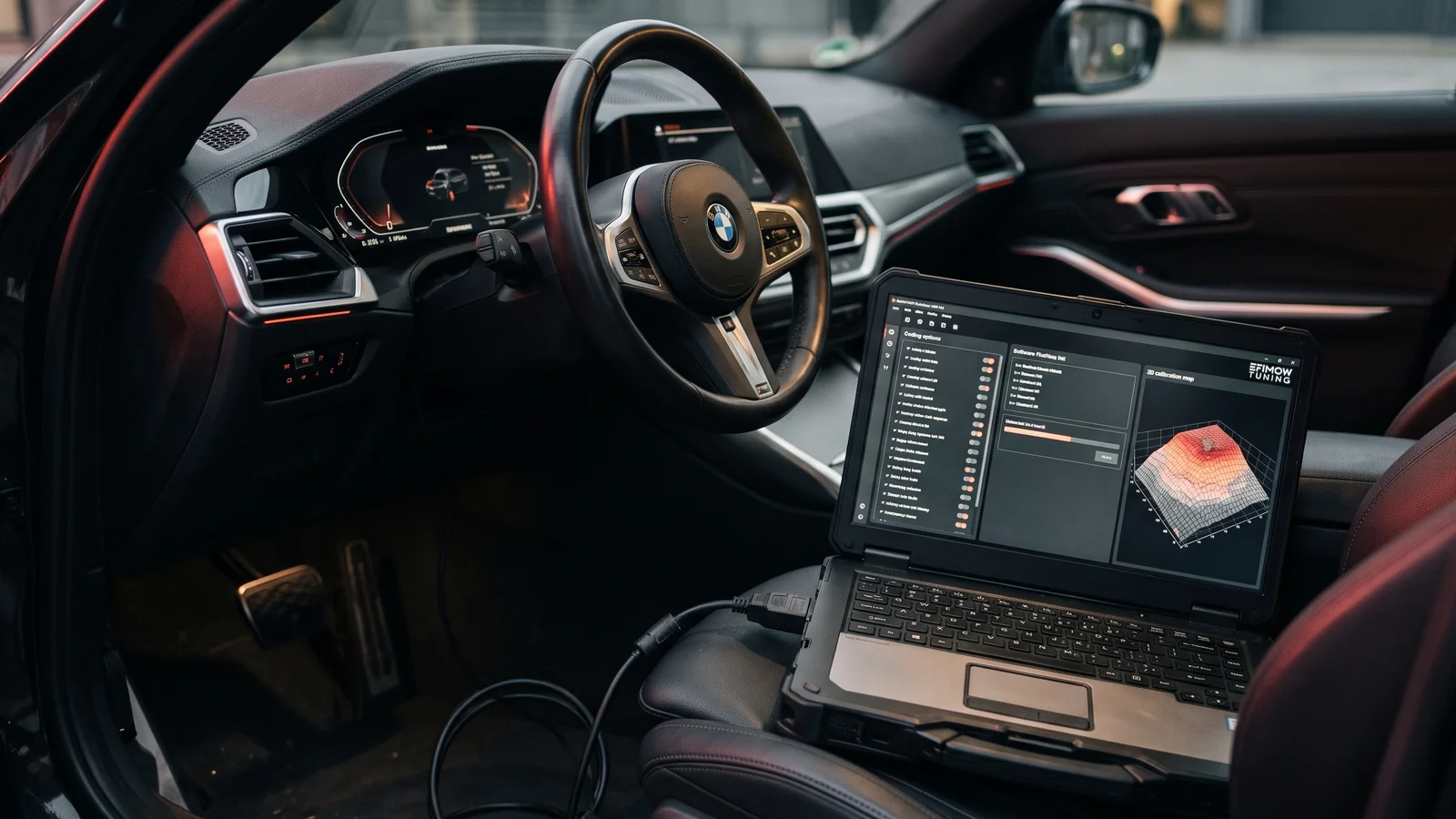
Coding, Programming, Tuning: The Difference on a BMW
Coding changes settings, programming installs new software, tuning changes the calibration. What the three terms mean on a BMW and where they overlap.
October 26, 2026 by Leo Efimow
In BMW forums and workshop conversations, three terms get mixed up all the time: coding, programming and tuning. "I coded my car" can mean the comfort indicator now flashes five times instead of three. "The ECU was programmed" can mean a factory update at the dealer. And "tuning" usually means the calibration of the engine software. All three run through the same OBD socket, often with similar-looking tools, but they intervene in completely different places. Knowing the difference also explains why a workshop visit can overwrite your tune and why a coding app does nothing for engine power.
Coding: settings in existing software
Coding does not install new software. The software in the control unit stays as it is. What changes are coding data. Think of them as switches and settings that adapt the same software to different cars and equipment.
BMW builds many control units for numerous models and countries. Whether a car has a tow bar, which lighting functions are permitted in which country or how certain comfort functions behave is set by coding. The basis is the vehicle order, the list of equipment the car was built with.
Typical examples of coding owners do themselves:
- the number of flashes of the comfort indicator,
- the behaviour of welcome and goodbye lights,
- displays in the instrument cluster or infotainment,
- the behaviour of comfort functions when locking and unlocking.
Classic tools are NCS-Expert for the E-series, E-Sys for F and G models and, for many users, apps such as BimmerCode. Worth knowing: coding can also affect functions relevant to road approval, for example lighting. What is technically codable is not automatically permitted on public roads.
Programming: installing new software
Programming replaces the software of a control unit wholly or partly with different software. This is how the manufacturer fixes bugs, carries out recalls or puts a new control unit into service.
At the dealer this runs through the dealer software ISTA (programming used to have its own variant, ISTA/P). For E models, BMW's tools also included WinKFP. Programming gives the control unit a new software version; afterwards it is usually coded again to match the vehicle order.
This is where programming and tuning touch: when the workshop programs your engine ECU, the area containing the tuning calibration is overwritten as well. The car then runs stock software again, often a newer software version than before.
Tuning: changing the calibration
Tuning in the sense of software optimisation neither flips a switch nor installs new manufacturer software. What changes is the calibration of the engine ECU: the maps, curves and limits the software calculates with. Boost targets, torque limits, ignition timing or, on a diesel, rail pressure: these are values, not switches.
Technically the calibrated file is written to the ECU with a flasher tool. That resembles programming, but in content it is something else: the software logic as a rule stays unchanged, the numbers change. The basis is always the original file of your ECU, because the calibration belongs to exactly that software version. More in The original file.
The three terms compared
| Coding | Programming | Tuning | |
|---|---|---|---|
| What changes? | settings and switches | the software version | maps and limits of the engine software |
| Typical tools | NCS-Expert, E-Sys, coding apps | ISTA, for E models also WinKFP | flasher tools |
| Who typically does it? | owners, coders, workshops | dealer workshop | tuners, in the BMW online process you yourself with our file |
| Power affected? | no | no, apart from possible changes by the update | yes, that is the point |
| Typical reason | comfort, retrofits | update, recall, ECU replacement | more power, driving behaviour |
Where it collides in practice
Most misunderstandings arise in two places.
First: the workshop visit. If your car gets a software update at a service and the engine ECU is programmed, the calibration is gone afterwards. Often the ECU then also has a new software version. Your old original file no longer matches the version in the car, and a new calibration requires a fresh read. If you want to keep your tune, talk to the workshop before the appointment about which control units are to be updated.
Second: coding after tuning. Coding other control units, for example lighting or the instrument cluster, does not touch the engine software calibration. Be careful as soon as a tool offers to program or "update" the engine ECU itself. That is not coding but programming, with the consequences described.
Why coding does not add power
A common question: "Can't you just code more power?" On a BMW, an engine's output is not stored as a switch in the coding. Different power levels of the same engine differ mainly in the calibration of the engine software, sometimes also in hardware. Anyone who wants to change the output has to work on the calibration, and that is tuning, not coding. What a Stage 1 calibration actually changes is covered in What is Stage 1 chip tuning?.
What this means for your BMW process
With BMW tuning through our online process, you read your ECU yourself via OBD, upload the original file to the customer portal and later write the finished calibration back with your flasher tool. Coding and workshop updates are separate from that. Two rules help:
- No factory update between reading and flashing. Otherwise the calibration no longer matches the version in the car.
- Check after a workshop visit. If the engine ECU was programmed, get in touch before flashing an old tuning file.
Common questions from practice
Does coding erase my tune? Coding other control units does not. It only becomes critical when the engine ECU is programmed.
Can I keep coding after the tune? Yes, comfort and display functions on other control units can be coded as usual. Just make sure your coding tool does not reprogram the engine ECU in the process.
Is programming done at every workshop visit? No. Whether control units are updated depends on the reason for the visit, for example a recall or a measure the manufacturer specifies for your car. Ask beforehand, then you know where you stand.
Is flashing back the original file the same as a factory update? No. Flashing back restores the version that was in your ECU before the tune. A factory update installs a new version that may differ from it.
Legal framework
Changing the engine software voids the car's type approval. Our calibrations are intended exclusively for motorsport. The details are in the motorsport notice.
Conclusion
Coding sets functions in existing software, programming replaces the software, tuning changes the calibration of the engine software. All three run through the same socket but are clearly separate. Knowing that avoids the most common surprise: a factory update that quietly overwrites the calibration. You can find your car in the configurator; terms such as E-Sys or ISTA are explained in the glossary.