
10 Chip Tuning Myths Fact-Checked
Does chip tuning ruin the engine? Is it invisible? Does it always save fuel? Ten common myths about software tuning and what is really true.
October 25, 2026 by Leo Efimow
Hardly any car topic is surrounded by as much half-knowledge as chip tuning. In pubs, forums and comment sections, claims circulate that are sometimes too optimistic and sometimes too gloomy. We have collected ten of the most common myths and put them into perspective, soberly and from a workshop point of view.
Myth 1: "Chip tuning ruins every engine"
False, with a caveat. A proper software tune uses reserves the manufacturer planned for production tolerances, climate, fuel quality and marketing. Protective functions such as knock control, exhaust temperature limits and torque limits stay active and are matched to the new load points. An engine in good condition with sensible maintenance usually copes with that.
What is true: a poor calibration, a worn engine or a driving style with a cold engine and constant full throttle can speed up damage. The condition of the vehicle and the quality of the calibration decide, not tuning as such.
Myth 2: "Every engine has 30 per cent in reserve"
False. The reserves differ enormously. Turbo engines often have a lot of headroom because the charge can be increased via boost. For current turbo diesels, typical Stage 1 guide values are around 15–30 % depending on the ECU family. Naturally aspirated engines are a completely different case: for many families the typical guide values are only 3–8 %. Anyone promising big jumps on a naturally aspirated engine is promising too much.
Myth 3: "A tuning box is the same as chip tuning"
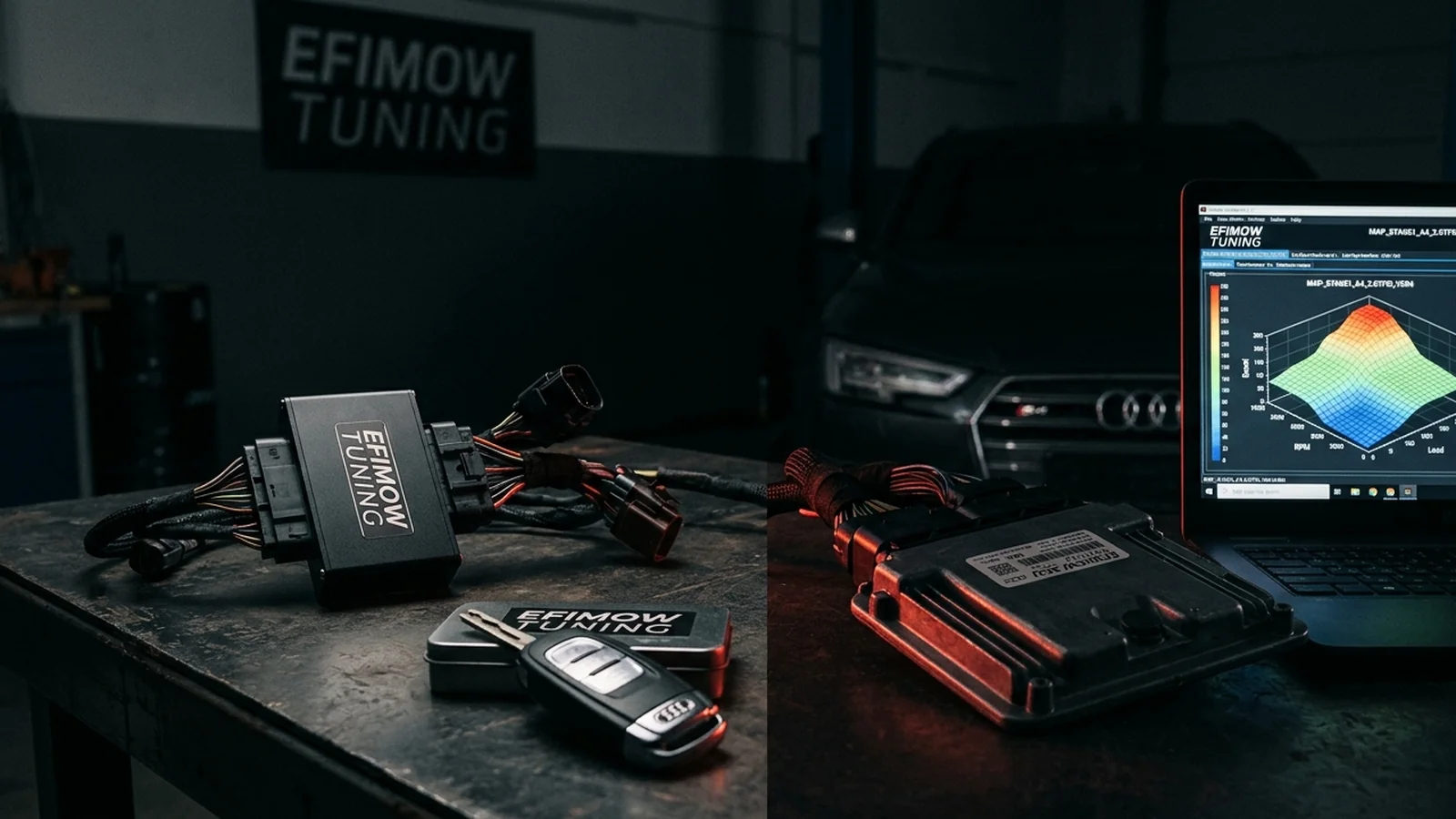
False. A tuning box sits between a sensor and the ECU and falsifies a signal, usually rail pressure or boost. The ECU believes pressure is missing and compensates. The actual software stays unchanged, but its protective functions work with false input values. Real software tuning changes the target values in the ECU itself, keeping all limits in view.
Myth 4: "Software tuning is invisible"
False. Modern diagnostics can read software version, checksums and in some cases programming counters. A dealer workshop can therefore tell that the ECU has been written. Flashing back to the original software is possible but does not erase every trace. Anyone advertising "invisible" is not telling the truth.
Myth 5: "Tuning always saves fuel"
Partly. More torque at the bottom end can lead you to drive with less throttle and in higher gears. Then consumption can drop. If you use the extra power, however, you consume more. ECO tuning targets consumption specifically: torque is optimised in the low and mid range while peak power stays the same. There is no guarantee of lower consumption, because driving style has the biggest influence.
Myth 6: "The warranty is gone immediately"
More nuanced. A warranty is a voluntary promise by the manufacturer with its own conditions. Statutory liability for defects is the seller's legal obligation. A software change can put claims at risk, especially if damage is linked to the change. A blanket "everything is gone" is as wrong as "it changes nothing". Read your vehicle's warranty terms before you decide.
Myth 7: "A little tuning is legal"
False. There is no "little". Any change to the engine software voids the type approval unless the change is inspected and registered. That applies to 10 hp just as to 100 hp. Our software functions are intended exclusively for motorsport. Details are in the motorsport notice.
Myth 8: "Removing the DPF gives real power"
False, and prohibited too. A clean particulate filter with normal back pressure costs a healthy engine hardly any power. Problems usually come from a clogged filter, and then the cause needs finding, not the filter removing. Removing or disabling DPF, EGR, AdBlue/SCR or the catalytic converter is emissions tampering and prohibited on public roads.
Myth 9: "One file fits every car of the same model"
False. Even with the same engine there are different software versions, hardware variants and ECU versions. A proper calibration builds on the read-out original software of the specific ECU. On motorcycles, for that reason, we always read the original software first and adapt the file to it.
Myth 10: "Diesel tuning means a black cloud"
False. A cloud of soot under load is not a sign of power but of too much fuel relative to air. A clean calibration ties fuel quantity to the actual air mass so the engine does not smoke. Modern diesels also have a particulate filter that fills up faster with lots of soot. If you want smoke, you want the wrong thing.
What counts in the end
Behind most myths is a true core that has been generalised. The key facts in short:
| Question | Short answer |
|---|---|
| Will the engine cope? | Usually yes, with good condition and a proper calibration |
| How much does it bring? | Turbo a lot, naturally aspirated little |
| Can it be detected? | Yes |
| Is it legal? | Only with inspection and registration, otherwise the type approval is void |
| May the emission control go? | No |
How to get reliable information
For your specific vehicle, the configurator shows typical guide values, the available options and the price. For BMW you order online, flash it yourself via OBD and pay for the software only once it is finished. For other brands you come to Stödtlen or send in the ECU. An overview of vehicles is under tuning.
Conclusion
Chip tuning is neither a miracle cure nor an engine killer. It is a shift of target values within existing reserves whose size depends on the engine. Honest figures, a healthy engine, active emission control and clear statements on the legal position separate proper tuning from pub promises. More on the basics in the glossary under Stage 1.