
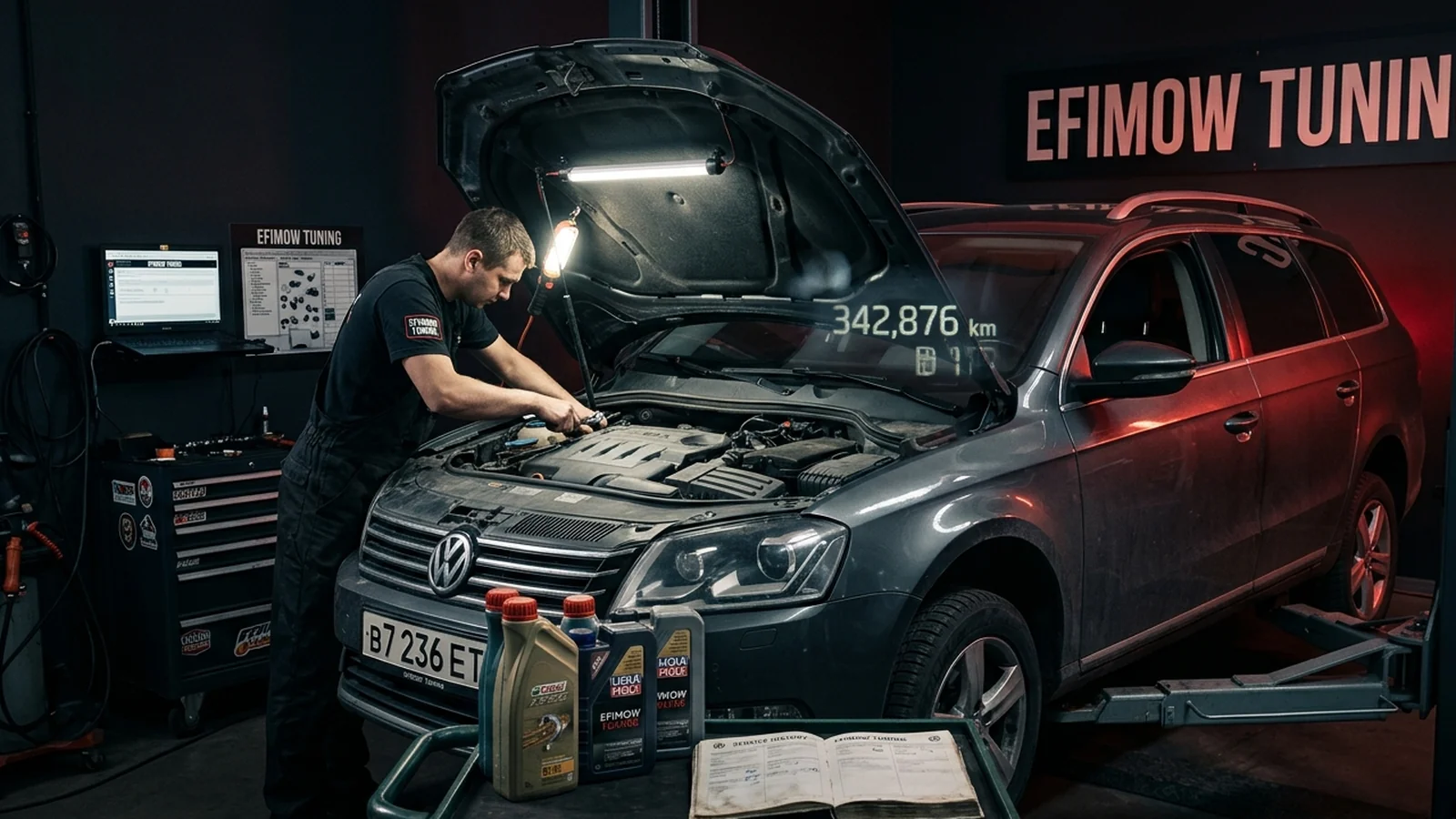
High Mileage and Tuning: When It Makes Sense
Tuning at 150,000, 250,000 km or more? Why condition matters more than the odometer, what to check beforehand and when you should leave it.
October 25, 2026 by Leo Efimow
"Is tuning still worth it at my mileage?" We hear this question often, mostly about diesels with six-figure mileage. The honest answer: the odometer alone decides little. A well-kept engine with 250,000 kilometres can be a better candidate than a neglected one with 90,000. What counts is condition. Here you learn what matters, what to check beforehand and when it is better to leave it alone.
Why mileage alone says little
An engine does not wear evenly with every kilometre. Long motorway runs with warm oil load it very differently from short winter trips. Regular oil changes with the right specification keep bearings and turbocharger healthy; overlong intervals do the opposite. A car with a complete service history and 200,000 motorway kilometres often has less wear than one with 100,000 kilometres of city traffic.
Software tuning uses the reserves the engine and its peripherals have from the factory. These reserves do not shrink just because the odometer reads higher. They shrink when components are worn: a turbo with bearing play, injectors with a poor spray pattern, a clutch near the end of its life.
What typically declines with age
| Component | Typical problem at high mileage | Consequence after tuning |
|---|---|---|
| Turbocharger | bearing play, coked actuation | boost fluctuates, faults, damage in the worst case |
| Injectors (diesel) | poor spray pattern, high quantity deviation | smoke, rough running, higher temperatures |
| Clutch / dual-mass flywheel | wear, rattling | slipping under the higher torque |
| EGR and intake | coking | less air, more soot |
| Particulate filter | high loading, ash | more frequent regeneration, back pressure |
| Spark plugs, coils (petrol) | wear | misfires under load |
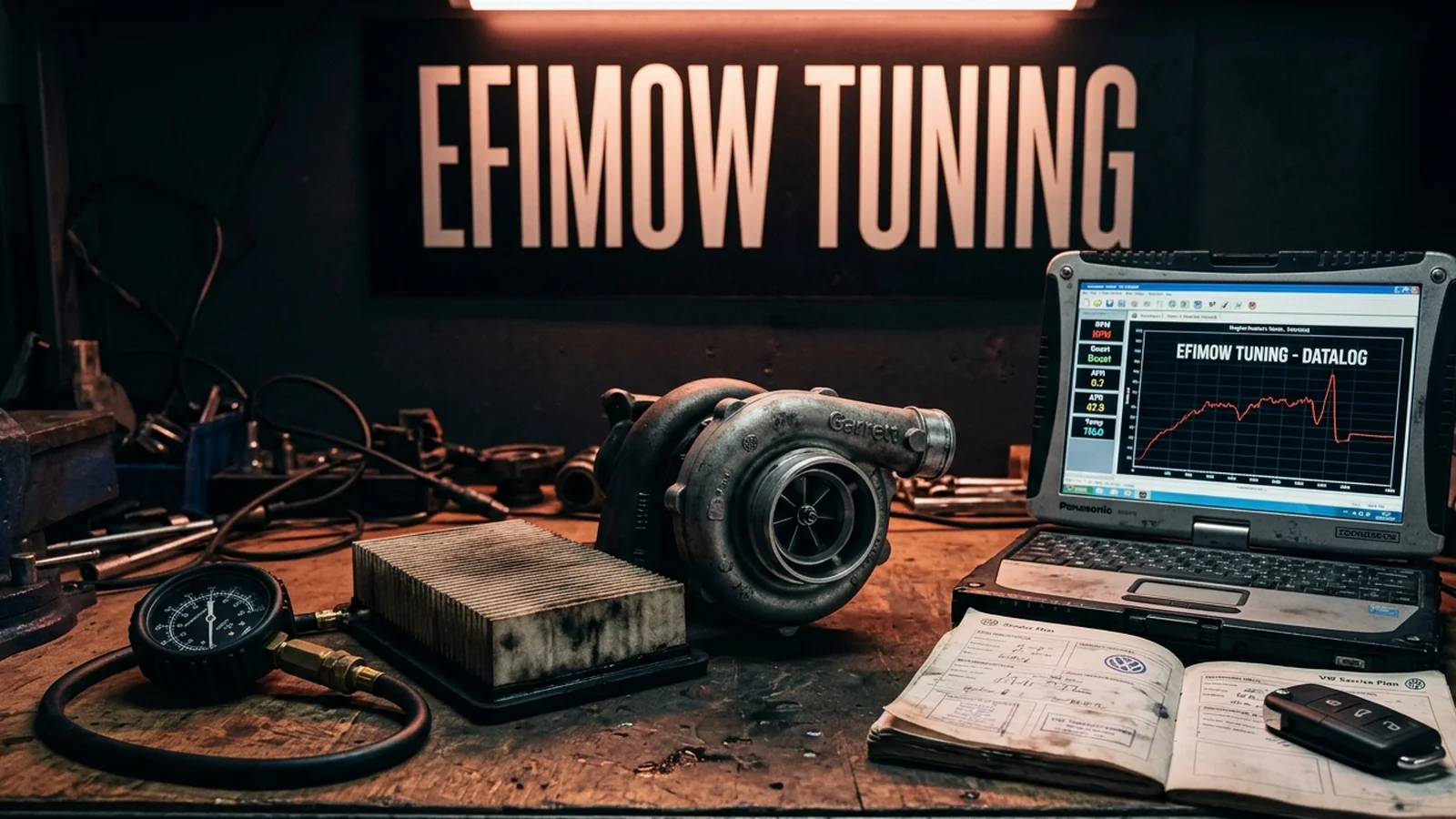
None of these rules out tuning. But each should be known and in order beforehand.
What to check before tuning
Service history: oil changes at what intervals, with which oil? Have the timing belt, clutch, turbo or injectors ever been replaced?
Fault memory: reading all control units shows whether there are known problems. Stored faults for boost, rail pressure, lambda or misfires are a clear stop signal until the cause is fixed.
Live data: a logged test drive shows whether boost and rail pressure follow their targets, what the injector quantity deviations look like and whether temperatures are plausible. That tells you more about the engine than any odometer.
Visual check: oil residue on the turbo, leaks in the charge-air system, cracked hoses. A small charge-air leak costs power in stock form, and even more after tuning.
Compression: if you doubt the engine's condition, a compression or leak-down test shows how healthy piston rings and valves are.
Diesel and petrol: different weak points
On a high-mileage diesel, injectors, turbocharger, EGR and particulate filter take centre stage. A diesel that already smokes or regenerates frequently in stock form will not get cleaner after tuning. On turbo petrols, spark plugs, ignition coils and, on direct injection engines, deposits on the intake valves are typical topics. Misfires under load show up sooner with more boost.
For both: wear parts that are due soon anyway are best replaced before tuning. Then the new calibration starts from a clean base.
When tuning at high mileage makes sense
- The engine is well kept, the service book complete.
- Fault memory and live data are unremarkable.
- Clutch and gearbox are in good condition or have been renewed.
- You mainly want more everyday pull, not constant full throttle.
In these cases a moderate Stage 1 or ECO tune can noticeably upgrade a high-mileage vehicle. Diesels that do a lot of motorway driving are a common case.
When you should leave it
- There are stored faults with an unclear cause.
- The engine uses noticeable amounts of oil or smokes.
- The clutch already slips in stock form.
- A major repair is due anyway.
Then: repair first, think about tuning afterwards. Software cannot heal a tired engine; it brings its weaknesses to light sooner.
Maintenance after tuning
With tuning, care becomes more important, not less. Oil changes a little earlier than the interval, regular air filters, and warm the engine up before you use the power. After a longer full-load run, let it idle briefly so the turbo can cool down. These rules apply to every engine, and all the more to one with high mileage.
Process and price
Whether your vehicle can be calibrated and what it costs is shown in the configurator. The price depends on the ECU generation, not on mileage. For BMW you order online, flash it yourself via OBD and pay for the software only once it is finished; the file is usually ready within 48 hours. For other brands you come to Stödtlen or send in the ECU. In both cases mention known previous damage or replaced parts; it helps with the calibration.
Legally, regardless of age: changing the engine software voids the type approval, and our software functions are intended exclusively for motorsport. More in the motorsport notice.
Conclusion
High mileage is not a reason to rule out tuning; poor condition is. Check service history, fault memory, live data and the usual wear parts. If everything is in order, a moderate tune can still give a car with 200,000 kilometres noticeably more pull. If not, the repair comes first. More on data logging in the glossary under logging.