
Tricore boot mode: what happens when the ECU is opened
Why some ECUs can only be read with the housing open, how Tricore boot mode works and which risks are involved, explained factually.
October 25, 2026 by Leo Efimow
On many modern vehicles the OBD socket is no longer enough to get at the engine software. Then the ECU has to come out and sometimes be opened. Boot mode on ECUs with an Infineon Tricore processor is the deepest access there is. To many customers "opening the housing" sounds like a risky operation. That isn't entirely unfounded: there are risks, and they mainly depend on how carefully the work is done. Here is what happens, why it is needed at all and what matters.
Why boot mode at all?
ECU makers protect their software more and more. In the past you could read an ECU via OBD, change the file and write it back as long as the checksum was correct. Today many ECUs additionally check a cryptographic signature. The bootloader only starts software signed by the manufacturer. At the same time many units lock read access through the diagnostic interface.
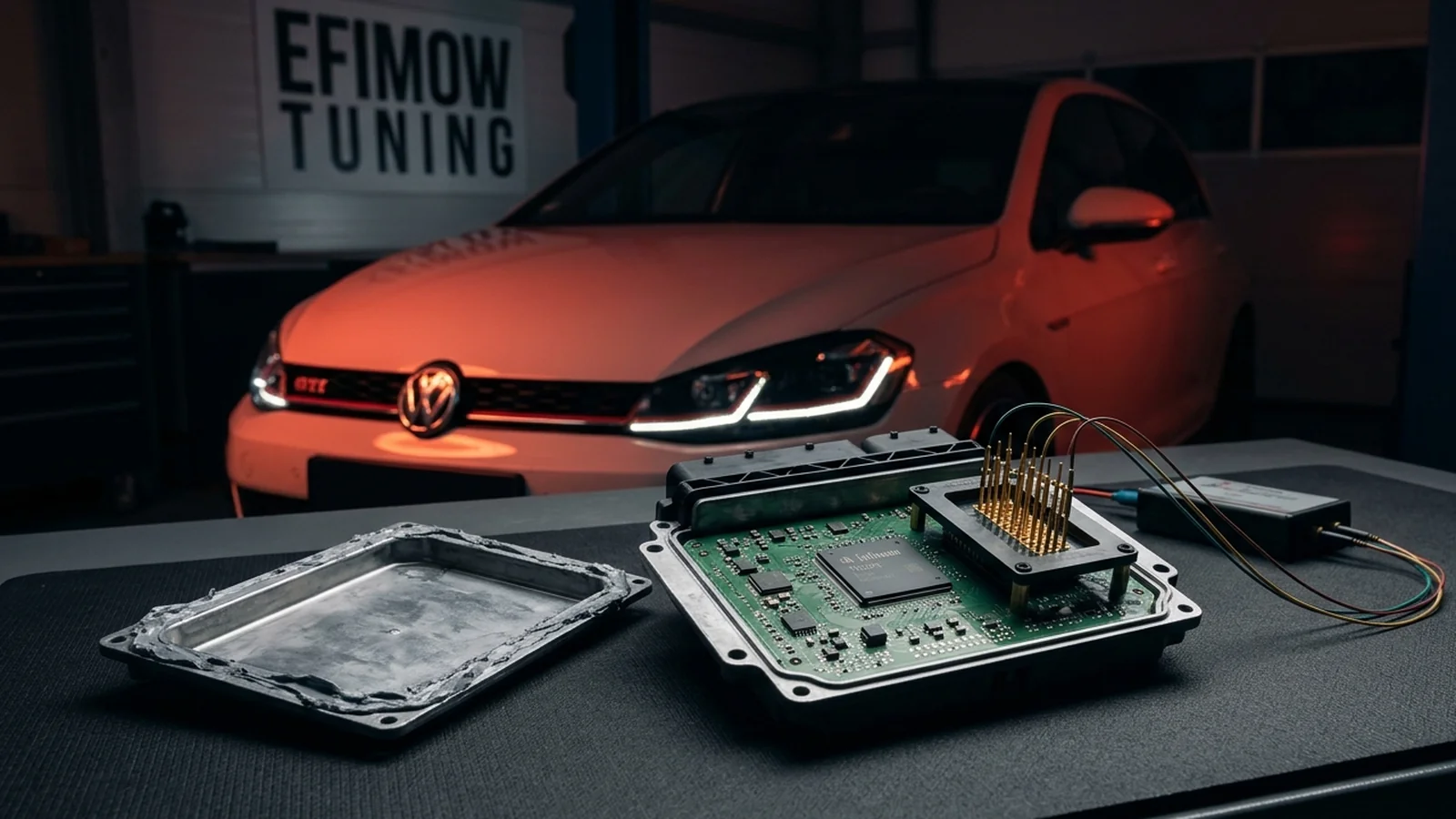
This mainly affects younger generations: the Bosch MG1 and MD1 families, Continental Simos 18/19 and Bosch generation-17 ECUs with newer protection. For such units there are two routes: access on the bench via the connector, if a tool exploits a gap in the protocol, or boot mode if that doesn't work either. A well-known example is the VW Golf 7 GTI with 220 PS with a Simos 18: here the ECU has to be opened or worked on at the bench for access.
What Tricore and BSL mean
Tricore is a microcontroller family by Infineon found in many engine ECUs, including Bosch and Continental generations. Like many processors, a Tricore has a built-in bootstrap loader (BSL). It is a small program inside the chip itself, independent of the ECU maker's software.
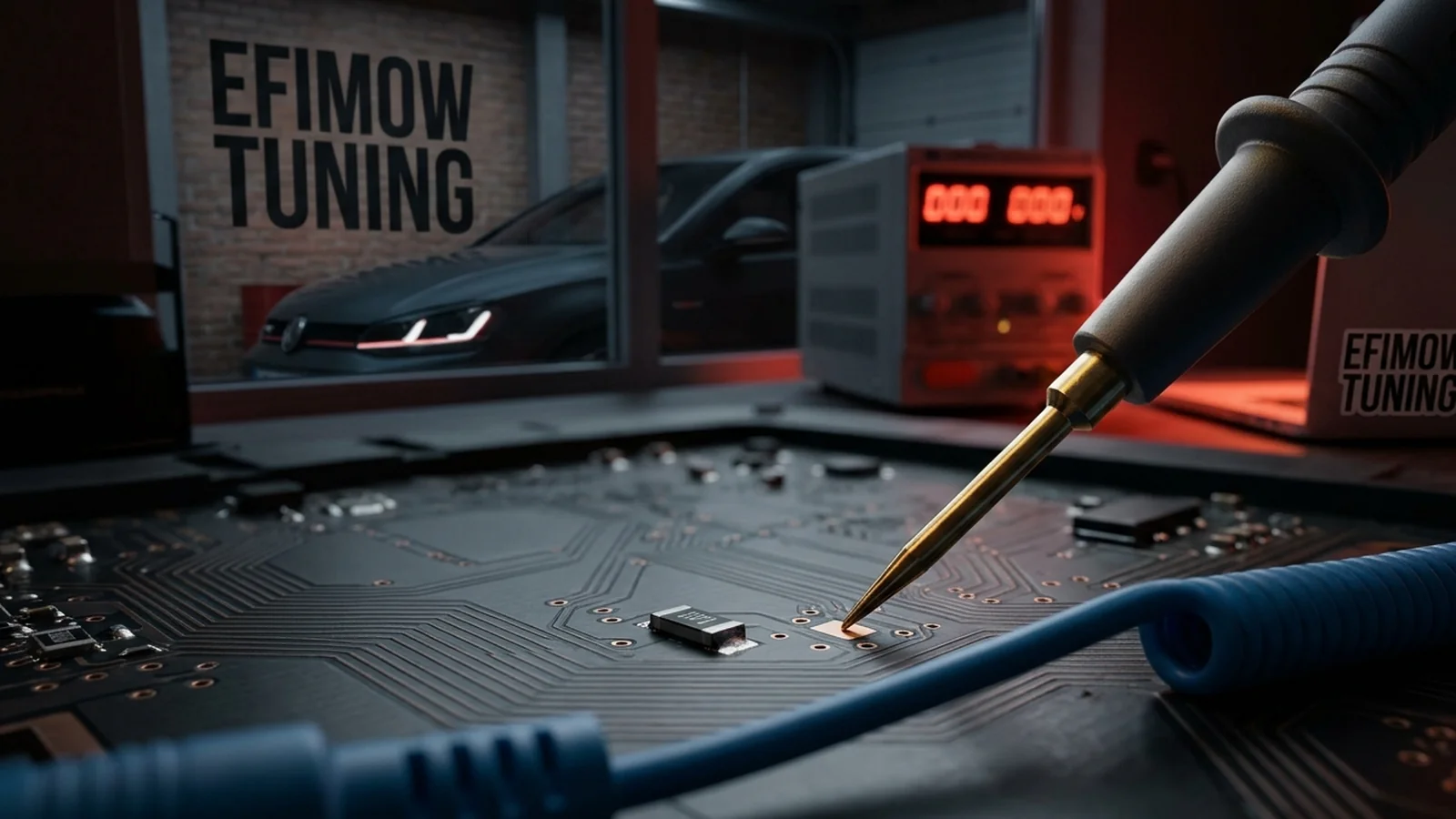
In normal operation the processor starts the software in flash. If a particular pin is deliberately set at power-up, however, it jumps into the BSL instead. Through it you can then communicate with the memory, bypassing the ECU maker's bootloader. That is why boot mode can often read and write even when OBD and bench are locked. Often the complete memory including the data area can be saved this way as well.
What happens at the workstation, step by step
- Removal and identification. The ECU is removed and its hardware and software numbers noted. They determine which contact points and which procedure are right.
- Opening the housing. Many ECUs have an aluminium lid that is glued or sealed with sealant. It is released carefully, without bending the board underneath or prising off components.
- ESD protection. Work is done on a grounded mat with a wrist strap. Static charge you can't even feel can damage sensitive components.
- Making contact. The tool is connected to defined points: supply, ground, communication lines and the boot-mode pin. Depending on the unit via spring contacts in a frame, via probe tips or via briefly soldered wires.
- Stable voltage. A lab power supply feeds the ECU. Voltage dips during reading or writing are the classic cause of aborted operations.
- Read and save. First the existing memory is read completely and saved, before anything is written.
- Write and verify. Then the modified file is written and verified afterwards.
- Closing. Remove contacts, clean solder points, fit the lid and seal it properly again.
The risks, named honestly
| Risk | Cause | How to avoid it |
|---|---|---|
| Torn pad | too much heat or pull when soldering | spring contacts instead of soldering where possible; fine tip, short soldering time |
| Short circuit | slipped probe, solder bridge | firm contact seating, visual check before power-up |
| ESD damage | electrostatic discharge | grounded workstation, wrist strap |
| Aborted write | voltage dip, loose contact | lab power supply, check contacts first, backup first |
| Leaking housing | lid fitted without new sealing | fresh sealant, clean fit |
| Mechanical damage | lid forced off | proper tools and patience instead of a lever |
The biggest risk for later operation is often underestimated: sealing. Many ECUs sit in the engine bay and are exposed to splash water, temperature changes and condensation. A housing that isn't properly resealed after opening can draw in moisture. Sometimes that only shows up months later.
The second biggest risk is writing without a prior backup. With a complete backup, an ECU can usually be revived after an aborted operation. Without one it gets difficult.
Boot mode or bench: what's the difference?
Both routes start the same way: the ECU is removed and placed on the workbench. The difference lies in how the tool talks to the processor. With bench access the housing stays closed. The ECU receives power and signals through its own connector, as if it were in the car, and the tool uses a diagnostic or service function of the ECU software. In boot mode that software is never started; the tool talks directly to the bootloader in the chip.
That gives a simple order: if an ECU can be reached on the bench, that is the gentler route because the housing stays closed. Boot mode comes in when bench access doesn't work for the software version, when a complete backup is needed, or when an ECU no longer responds after a failed write. So which route is needed is not the tuner's preference but the ECU's protection level.
What you can expect as a customer
An opened ECU is no blemish if the work was clean. Usually only traces on the housing remain visible, for example at the seal. Functionally, a properly closed ECU makes no difference.
A few points you can clarify:
- Is a complete backup made before writing? The answer should always be yes.
- Is the housing resealed? Not just "closed", but sealed.
- What does the access cost? With us, opening for bench or boot access adds a 50 € surcharge. It is already included in the displayed price when the ECU is known to need opening. That's why Stage 1 for the Golf 7 GTI above starts at 450 € instead of 400 €.
- On site or shipping? Both work and the price is the same. When shipping, only the ECU comes to us, which is why careful packing matters so much.
Legal framework
Whether OBD, bench or boot mode: changing the engine software voids the vehicle's operating permit. Our software modifications are intended exclusively for motorsport. Details are in the motorsport notice.
Conclusion
Tricore boot mode is not a hack but the use of a function the processor brings with it. It becomes necessary because modern ECUs sign their software and lock access via OBD. The risks are real but well manageable: ESD protection, stable voltage, clean contacts, a backup before writing and a properly resealed housing. Whether your ECU needs to be opened you'll see after choosing your vehicle in the configurator in the price breakdown, or just ask us beforehand.