
Teilegutachten, ABE, and Einzelabnahme: What German Tuners Must Provide
Three paths to legal road approval in Germany. Which is cheap, which is expensive, and which holds up best when it matters.
May 6, 2026 by Leo Efimow
In Germany, it is not enough for a tune to be technically clean. It has to be demonstrably legal on paper. § 19 StVZO only tells you when the road approval expires; the actual registration on the Fahrzeugschein (vehicle registration document) follows its own procedure. Three paths lead to a legal entry: the Teilegutachten (parts approval document), the ABE (general type approval), and the Einzelabnahme (individual inspection). They differ in cost, effort, and how well they protect the owner if something goes wrong. Anyone commissioning a tune should understand which path applies to their car, and what paperwork they must receive in return.
Teilegutachten: the most common path for software tunes
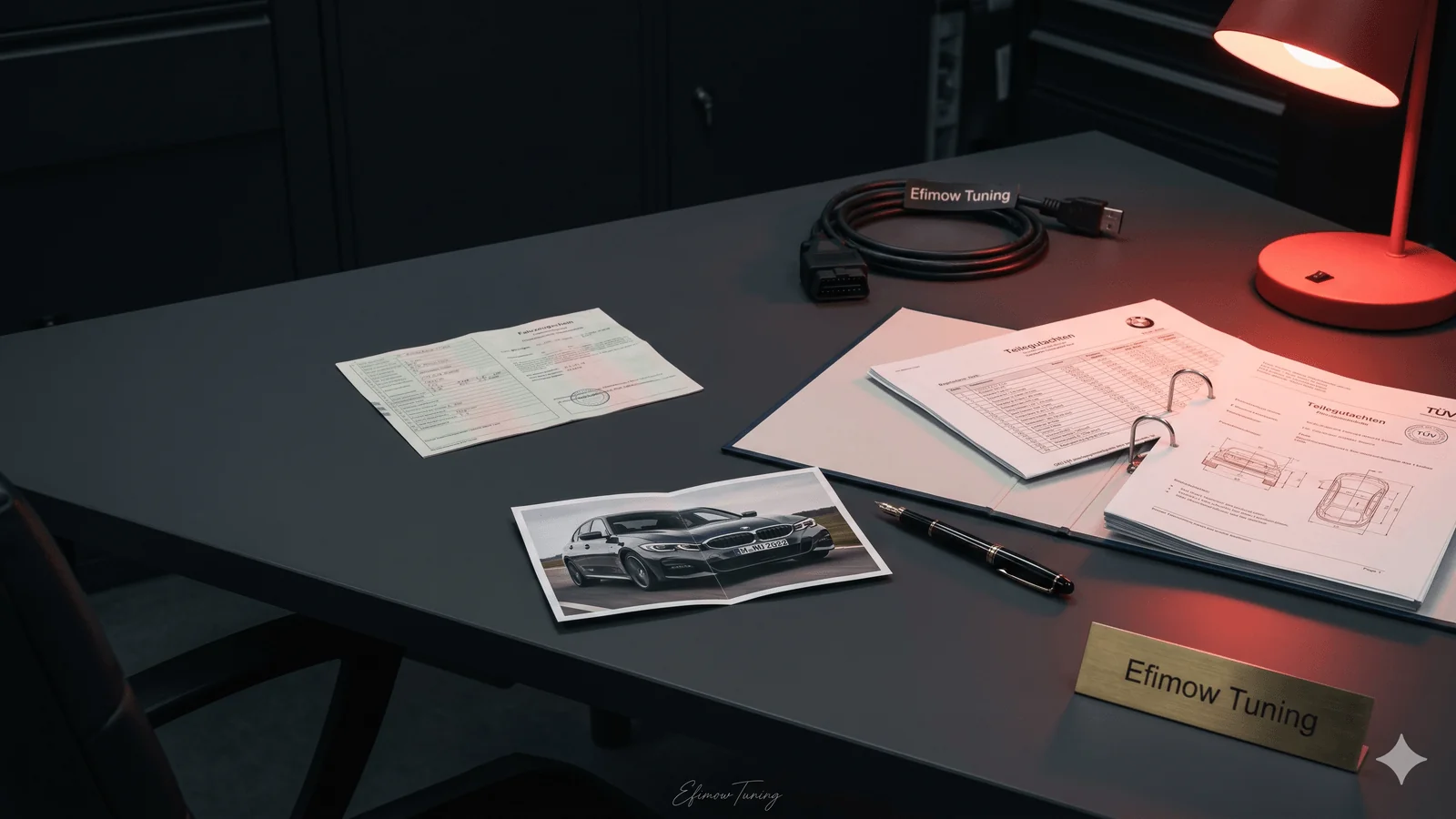
The Teilegutachten is by far the most common document in everyday tuning. It is created by the tuner together with an accredited testing organisation (TÜV, DEKRA, GTÜ, or a recognised expert) and describes the software modification for one specific vehicle-engine combination. The document lists the changed key figures (new rated power, new maximum torque, possibly revised rpm limits) and the conditions of use, such as required fuel grade or prerequisite hardware like an upgraded intercooler.
With a Teilegutachten in hand, the vehicle must be presented after the file is loaded to an officially recognised expert (amtlich anerkannter Sachverständiger, aaS) or inspection engineer (Prüfingenieur, PI). They check that the document's conditions are met, the model matches, and no safety-relevant defects are visible. The TÜV registration fee typically lies between 100 and 300 euros, depending on region and effort.
The advantage: cheap, predictable, routine. The disadvantage: a Teilegutachten only exists for the vehicle-engine combinations explicitly listed in it. For rare models, special engines or specific build periods there simply is none, and then the next path is the only option.
ABE: pre-approved, but rare in the software world
The ABE (Allgemeine Betriebserlaubnis, general type approval) is the more demanding sibling of the Teilegutachten. With an ABE, the German Federal Motor Transport Authority (KBA) has already centrally type-approved the modification. In the ideal case that means: no extra TÜV appointment, no entry on the Fahrzeugschein. The ABE is simply carried in the vehicle and serves as evidence in a roadside check.
In software tuning, however, the ABE is the exception. An ABE requires the approved "part" to be precisely defined and reproducible. Software calibrations vary too much across a model year (ECU generations, hardware revisions, update states) for a centralised type-wide approval to be economically practical. ABEs are more common on hardware (exhausts, wheels, suspension) than on pure chip tunes.
If a tuning package does come with an ABE, verify that your vehicle falls exactly within its scope. Even minor deviations (wrong engine variant, different model year, divergent hardware) invalidate the ABE.
Einzelabnahme: the most expensive but most universal path
When neither Teilegutachten nor ABE applies, the Einzelabnahme (individual inspection) under § 21 StVZO remains. The single vehicle with its specific software calibration is fully inspected. That includes measurements normally covered by the up-front document on the other paths: a noise measurement (stationary and drive-by under the applicable procedure), an emissions test at realistic load points, and where relevant a brake check and safety assessment.
Costs scale accordingly: typically 600 to several thousand euros, depending on the scope of measurements, region, and testing organisation. The timeline is longer too: several weeks can pass from the first call with an expert to the registration appointment.
The upside: an Einzelabnahme works for every case where neither Teilegutachten nor ABE is available. It is the universal fallback for rare vehicles, individual hardware combinations, and tunes that step outside standard packages. The downside, beyond cost and time, is that it applies to one specific vehicle only; after a later software change a fresh inspection is due.
Comparison at a glance
The three paths line up cleanly against each other in a single table:
| Criterion | Teilegutachten | ABE | Einzelabnahme |
|---|---|---|---|
| Typical cost (registration) | 100-300 € | 0 € (no TÜV appointment needed) | 600 € to several thousand € |
| TÜV appointment required? | Yes, brief | No | Yes, extensive |
| Time required | 1-2 weeks | immediate | several weeks |
| When applicable? | for models listed in the document | only with KBA type approval | always, as fallback |
| In a claim or accident | safe once registered | safe, ABE must be carried | safe, registered on Schein |
| On owner change | stays on the Schein | stays with the vehicle | stays on the Schein |
What ends up on the Fahrzeugschein
Whichever path is chosen: for Teilegutachten and Einzelabnahme, the result is documented on the Zulassungsbescheinigung Teil I (Fahrzeugschein), in the remarks field (field 22 on older documents). It typically lists the new rated power in kW, the underlying procedure ("Eintragung gem. § 19 Abs. 3 StVZO" or "Einzelabnahme nach § 21 StVZO") and, depending on the inspector, a reference to the underlying report or protocol.
This entry is the only legally binding proof. Anyone holding only a piece of paper from the tuner at home, with the car never actually registered, is still formally driving without road approval. All three paths only work once the second step (entry on the Fahrzeugschein) has been completed.
What you must receive from the tuner
Before any money changes hands, the tuner should state in writing which of the three paths applies to your car. With a Teilegutachten, a copy of the document is part of the standard delivery, not "you'll get it at the appointment", but up front as a PDF. With an Einzelabnahme, a written estimate of expected costs and the necessary measurement steps belongs in the package. Anyone who dodges this question, or says "we have contacts for that" without naming the procedure, is not selling a registration-ready tune; they are selling a risk.
Bottom line
Teilegutachten is the fast path, ABE is the textbook ideal, Einzelabnahme is the universal fallback. And the third one is what holds the German tuning landscape together legally, because it works even for rare configurations. In day-to-day work on the BMW G- and F-series, the Teilegutachten is usually the answer. Anyone ordering a software tune should hold the document in hand beforehand and book the appointment with the aaS or PI directly. The car then stays registered, insured and on the safe side, and the tune is recorded on the Fahrzeugschein where it counts in a dispute.