
PCMflash explained: OBD, bench and boot access at a glance
PCMflash is a modular program for reading and writing ECUs. How its modules work, which access routes exist and where the limits are.
October 25, 2026 by Leo Efimow
Anyone looking into chip tuning sooner or later comes across tool names: KESS, Autotuner, MPPS and PCMflash. At their core they all do the same thing: read the software from an ECU and write a modified version back. Still, they differ a lot in which ECUs they support and by which route. PCMflash has a structure of its own that tells you a lot about how ECU access works today. That makes it worth a closer look, even if you'll never operate the tool yourself.
What PCMflash is and what it isn't
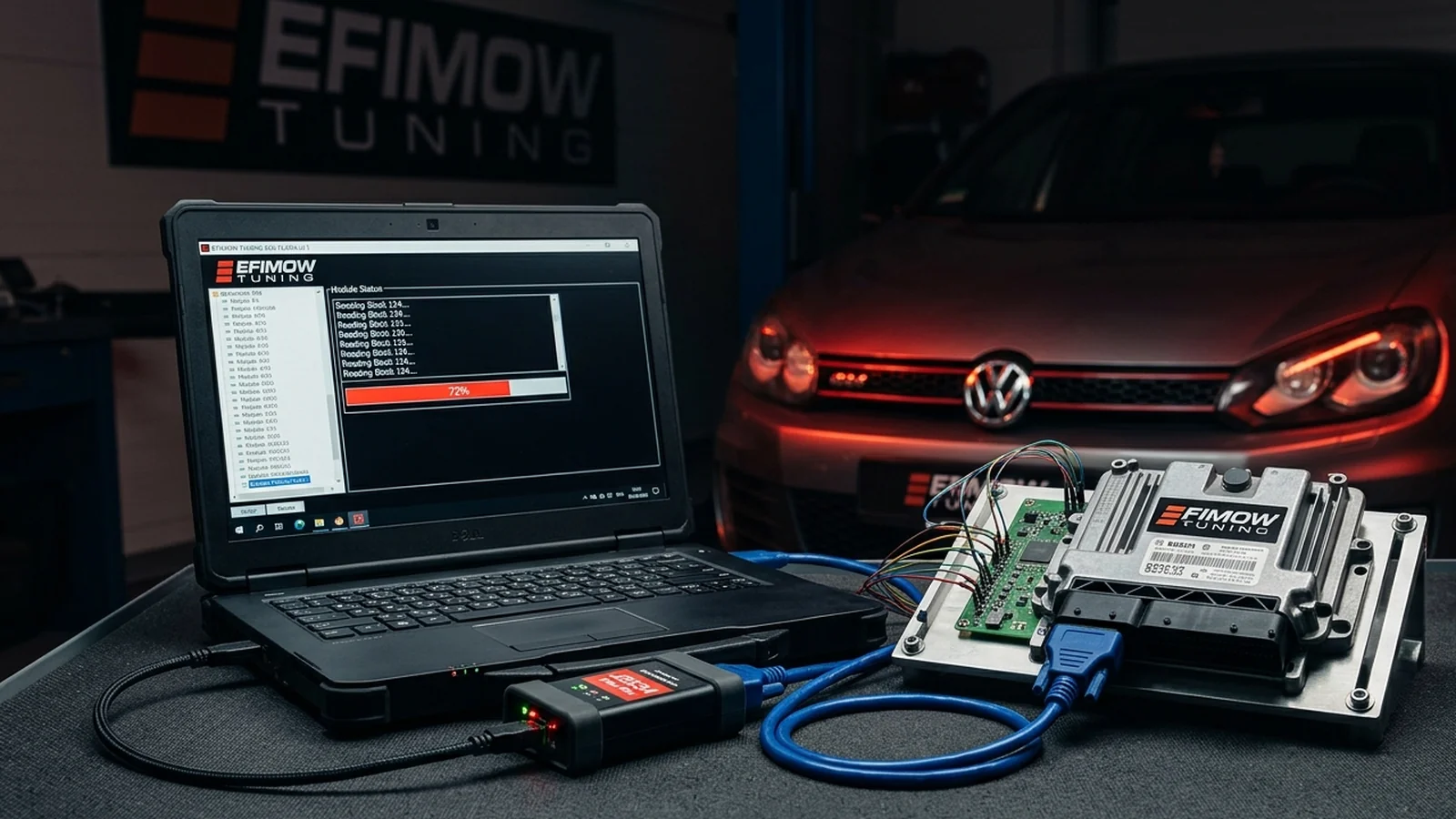
PCMflash is a Windows program for reading and writing engine and transmission control units. It doesn't come with its own fixed device but works with a J2534 interface, a standardised adapter between PC and vehicle. The Scanmatik 2 Pro is often named here and is explicitly required for some functions.
The distinction matters: PCMflash is a tool for access, not a tune. It moves files into and out of the ECU, corrects checksums depending on the module and handles the communication. What is in the file (boost, injection quantity, ignition timing, torque limiters) is decided by the calibration. A good flashing tool doesn't turn a bad file into a good one.
The module principle
PCMflash is split into modules. Each module covers a particular ECU family via a particular route. A module for Bosch EDC17 via UDS over OBD is different from a module for the same family on the older CAN TP2.0 or K-Line protocol. A bench module for Bosch ECUs on the table is yet another module.
Which modules are available depends on the version. Version 1.2.x contains modules 1 to 88. Newer versions have added more, for example a bench module for Bosch MD1 and MG1. That has a practical consequence: the question "Can PCMflash do my ECU?" can never be answered across the board. What it really means is: is there a module for exactly this ECU, on this access route, in this version? And does it support the software version that is in your car?
The three access routes
OBD: the normal case
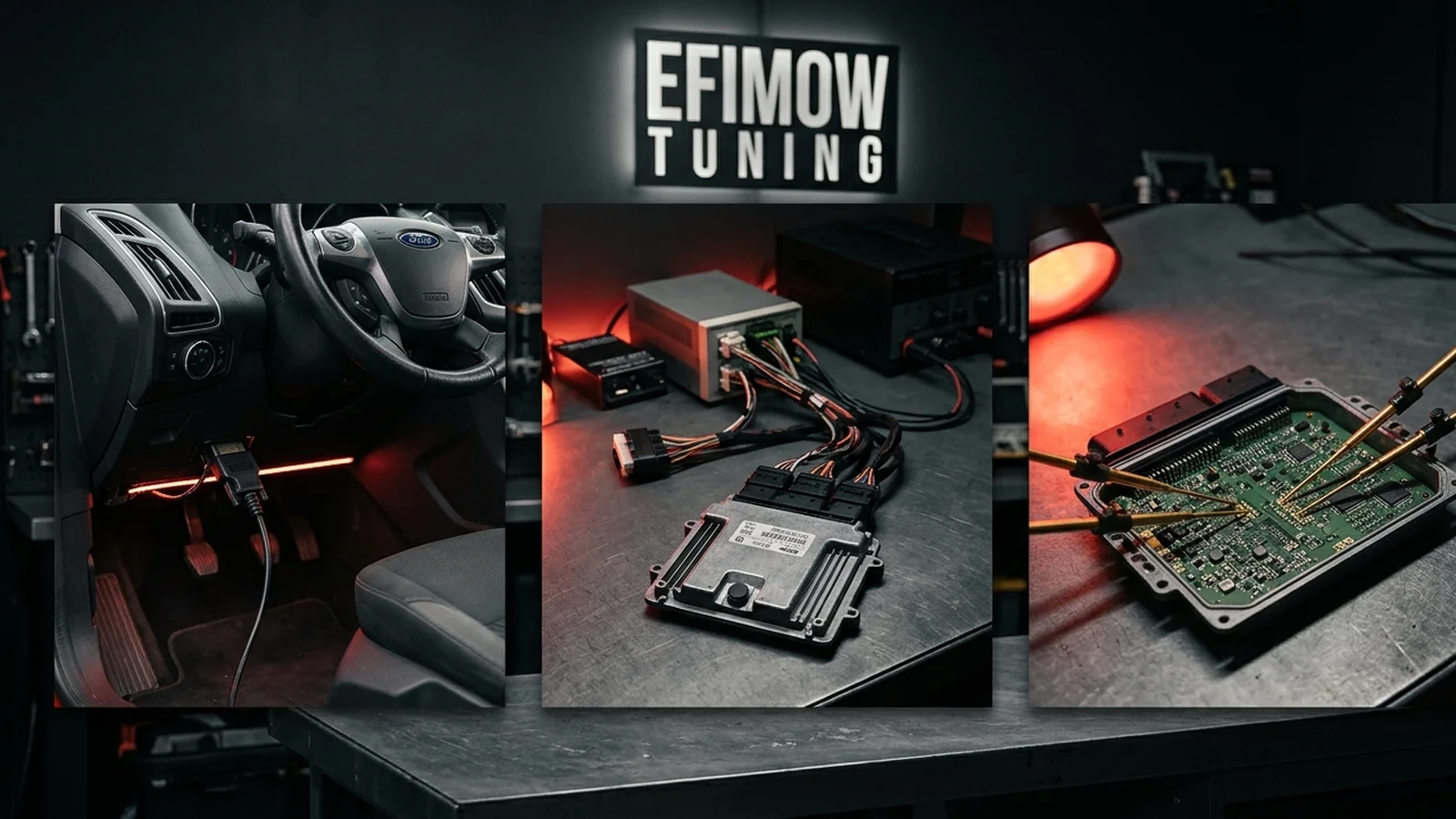
Most entries in the PCMflash module list run over OBD, i.e. via the diagnostic socket in the footwell. The ECU stays in the vehicle and nothing is opened. Typical examples are many Ford ECUs, older Continental and Siemens diesels and numerous Bosch generation-17 ECUs in the VW Group.
Even with OBD access there are differences in detail. Some modules read only the calibration area, not the complete software. On some VW Group ECUs (such as Bosch MED17.5 in the 1.2/1.4 TSI or EDC17 in the 2.0 TDI) PCMflash uses virtual reading: the calibration data is read, and the rest of the file is filled in from a database of original files. Other entries say "unlock required": the ECU has to be unlocked first, in some cases possible over OBD from a certain version on.
Bench: on the table via the connector
With bench access the ECU is removed and connected on the table via its own connector. A power supply feeds it and the adapter taps the required lines. The housing usually stays closed. PCMflash has dedicated modules for this, among them one for Bosch families such as EDC17 and MEVD17 in bench or service mode and another for older families such as ME9, MED9 and EDC16.
There is a separate bench module for the Bosch MG1/MD1 generation. According to the module list it initially only covered ECUs with protection up to around mid-2020. Support for BMW ECUs of this family with newer protection only came in later versions. This is exactly where you see how much the result depends on the software version inside the ECU.
Boot: housing open
Boot mode is the deepest access. The housing is opened and the tool talks directly to the processor's bootloader via contact points on the board. That often allows reading the complete memory even when OBD and bench are locked. In the module list this appears, for example, for Denso ECUs and for ECUs with an Infineon Tricore processor that are read via the bootloader (BSL).
Access routes at a glance
| Access | ECU | Intervention | Typical cases in the module list |
|---|---|---|---|
| OBD | stays in the car | none | many Fords, Continental/Siemens diesels, VW Group Bosch gen 17 |
| Bench | removed | connector on the table | Bosch EDC17/MEVD17 in service mode, ME9/MED9/EDC16, MG1/MD1 |
| Boot | removed | housing open | Denso via bootloader, Tricore ECUs via BSL |
Where the limits are
As extensive as the module list is, it has honest limitations, and some are written right into the entries:
- "Write + checksum only": the module writes and corrects the checksum but doesn't read by itself. The starting file then has to be obtained another way.
- Signatures: for VW Group MED9 the list explicitly notes that RSA signatures are not corrected. A checksum is a simple arithmetic check; a signature is cryptographic and can't simply be recalculated.
- Version dependency: many functions carry a note "since version …". If you use an older version, you don't have them.
- Hardware dependency: some protocols need a specific adapter, for example for older Ford ECUs.
That leads to a simple workshop rule: an entry in a compatibility list is a good hint, but not a promise. Before writing, it is checked which ECU with which hardware and software number is really fitted.
What this means for you as a customer
You don't need to know PCMflash to have your car tuned. But the knowledge helps you put a few things in context:
- Why the access route affects the price: if the ECU has to be opened for bench or boot work, that's more effort. With us it costs a 50 € surcharge, whether you visit us or ship the ECU.
- Why the original file matters so much: with virtual reading or partial reads, everything depends on the file matching the software version in the ECU exactly.
- Why claims like "works on every car via OBD" are wrong: modern, protected ECUs can often only be written on the bench or opened, and that is down to the manufacturer, not the tuner.
Which route your vehicle needs and what the calibration costs you'll see after selecting your vehicle in the configurator or on the vehicle page under tuning by brand.
Legal framework
No matter which tool writes the file: modified engine software voids the operating permit. Our software modifications are intended exclusively for motorsport; details are in the motorsport notice.
Conclusion
PCMflash is a modular tool that combines OBD, bench and boot access under one interface. Its module list shows very clearly how differently ECUs are protected: some can be read comfortably via the diagnostic socket, others only on the bench or with the housing open, and some only in certain software versions. For you as a customer, what counts in the end is not the tool but that the access route suits the ECU and the original file is properly saved. More on the terms is in the glossary under PCMflash.