
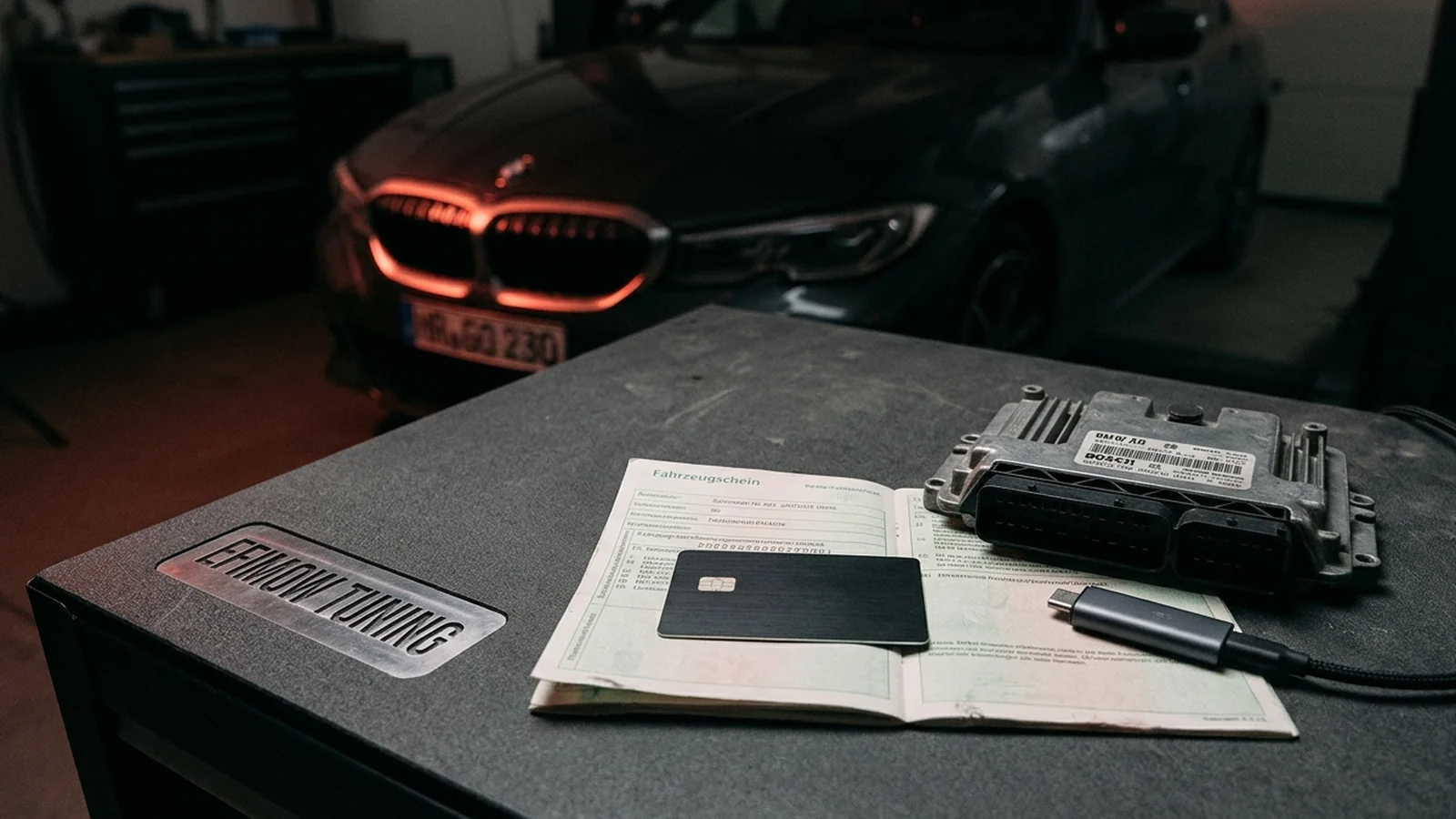
The VIN in Your ECU: What the Software Knows About Your Car
ECUs store the VIN, software versions, faults with mileage and learned values. What that means for data protection and for your original file.
October 26, 2026 by Leo Efimow
When you read your ECU for the first time, you think about maps and power. Many people are not aware that the file also contains information about their own car. A modern engine ECU is not just a computer that controls injection and ignition. It also knows which car it belongs to, which software it carries and what has happened during its operation. This post covers which data is typically stored in ECUs, what of it can end up in a read file and how to handle it sensibly.
What an ECU knows about your car
The exact scope differs by manufacturer and ECU. These groups are typical:
| Type of data | What is behind it |
|---|---|
| Vehicle Identification Number (VIN) | Most control units in modern cars store the VIN of the car they were fitted to and programmed for. |
| Part and software numbers | Hardware, software and calibration versions that identify the unit uniquely. |
| Coding | Settings matching the car's equipment. |
| Programming history | Many ECUs keep counters or entries about programming sessions. |
| Fault memory | Fault codes, often with environmental data such as mileage, engine speed or temperature at the time of the fault. |
| Learned values | Adaptations the ECU uses to compensate for component tolerances and wear. |
The VIN is the key here: it links all other data to exactly one car.

Is the VIN personal data?
On its own, the VIN describes a car, not a person. But as soon as it can be linked to a keeper (via vehicle documents, workshop records or a customer account), it can become personal data. That is generally how data protection treats it: as information through which a person can be identified.
For you as a car owner, this mainly means: the VIN is no secret (it is visible behind the windscreen), but together with other data it says more about you and your car than you might think at first glance.
What your original file may contain
When reading via OBD, depending on the ECU you get the complete flash, the calibration area or a file partly completed virtually. Which of the data above it contains depends on which areas are read. Identifiers such as software and calibration version are practically always included, because without them a calibration cannot be assigned. Vehicle-related data such as the VIN may be included too, especially with complete reads. The difference between the read types is explained in Virtual reading.
So treat your original file like a document that belongs to your car, not like an arbitrary file you pass around.
Practical rules for handling your files
- Do not share files publicly. An original file or tuning file does not belong in forums, public cloud links or group chats. It carries the identifiers of your ECU and possibly your VIN.
- Check screenshots. Many flash tools display the VIN and ECU data on screen. If you share a screenshot, for example to show a problem, black out the VIN, unless you send it directly to your tuner.
- Store safely, not openly. For the backup of your original file: at least two separate locations, but protected ones. A private cloud folder is something different from a publicly shared link. How to back up the file properly is covered in The original file.
- Think ahead when selling. When you sell your car, the files are part of the car's history. Whether you hand them to the buyer is your decision, but they contain details that will concern the buyer, no longer you.
- Other cars' ECUs. A used ECU carries the data of another car. That is one more reason why adapting it belongs in a specialist workshop; more in Fitting a used ECU?.
What happens to your VIN with us
We also process your VIN when you create a customer account and place an order. What happens to it is described in our privacy policy in the section on user account and order data. In brief:
- During registration and orders, name, email address, password (encrypted), VIN and address data are collected.
- This data is used for contract processing, provision of the tuning files and communication with you.
- The legal basis is Art. 6 (1) (b) GDPR, i.e. performance of the contract.
- The data is stored in the Firebase Firestore database, a service provided by Google.
- Personal data remains stored until the purpose of processing no longer applies. On a legitimate request for deletion it is deleted, unless statutory retention obligations, for example under tax or commercial law, stand in the way.
For questions about your data, the contact details of the controller are in the privacy policy.
Your rights
The GDPR gives you basic rights towards every company that processes your data. These include in particular the right of access to which data is stored, the right to rectification of incorrect data and the right to erasure, unless statutory retention obligations stand in the way. That applies to tuners just as much as to workshops, dealers or online services around the car.
Manufacturer diagnostics and traces
A related topic is not about data protection but traceability: manufacturer diagnostic systems can read software versions and in part also programming information. Flashing back the original file restores the software state but does not change the history. The post on the original file goes into this in more detail.
Apps, adapters and other services
It is not only tuners and workshops that see your VIN. Every diagnostic or coding tool that connects to your car can read it, including smartphone apps with a Bluetooth adapter or programs on a laptop. Many of these services work with an online account and transfer vehicle data to their servers, for example to unlock functions or store settings.
That is not a problem in itself, but it is worth handling consciously:
- Read the privacy notices of the apps and tools you use, especially if they require an account.
- Do not leave adapters plugged in permanently when you do not need them.
- Think about whom you give access to when someone offers to "quickly code something".
Legal framework
Changing the engine software voids the car's type approval. Our calibrations are intended exclusively for motorsport. The details are in the motorsport notice.
Conclusion
ECUs store more than maps: VIN, software versions, programming history, faults with mileage and learned values. Your original file may contain part of that. So do not share it publicly, black out the VIN on screenshots and store the file safely but protected. What we do with your VIN is set out in the privacy policy; if you want to select your car, start in the configurator.