
Tuner-Backed Extended Warranties: Real Protection or Expensive Peace of Mind?
What tuner-backed warranties actually cover, what hides in the fine print, and how to spot a reputable provider.
May 6, 2026 by Leo Efimow
The moment the factory warranty runs out (or gets voided by a tune), the same question shows up in nearly every customer email: do I need an extended warranty, and which provider can I trust? The market is messy. Stage X, Kueberl, GAN Tuning, and a long tail of smaller brokers all advertise packages that look reassuring at a glance and surprisingly full of holes once you read past the cover page. This article explains what a tuner-backed warranty actually is, how to recognize a reputable policy, and when the surcharge is genuinely worth paying.
What a tuner-backed warranty actually is
A piece of context first. A "warranty" in this market is legally not a classic insurance product. It is a contractual assurance, usually from the tuner themselves, sometimes administered through an external warranty provider. It triggers when a covered component fails inside the contract period due to a material or production defect. It is not a replacement for comprehensive auto insurance, not a replacement for the manufacturer's warranty, and it does not cover wear and tear.
With reputable providers, the price sits at a one-time 150 to 500 Euro per term, depending on vehicle class, mileage, and coverage cap. For an M340i with Stage 1, expect 250 to 400 Euro to be realistic. Anyone offering you full coverage for 50 Euro is not selling a product. They are selling a promise wrapped in very narrow exclusions.
What is covered and what is not
Practically every policy defines a component list. Standard inclusions: the engine (block, pistons, rods, crankshaft, cylinder head), the turbocharger, the high-pressure fuel pump, and in better packages the timing chain. Some tuners include the gearbox, many do not, especially the ZF 8HP Steptronic, because it carries the highest claim risk under aggressive tunes.
What is essentially never covered: wear items (brakes, clutch, tires), bolt-on parts (sensors, actuators, control motors), consequential damage outside the drivetrain, and anything that can be classified as "improper use": a clause that gets interpreted very generously when a claim is filed.
Deductible, coverage cap, mileage limit
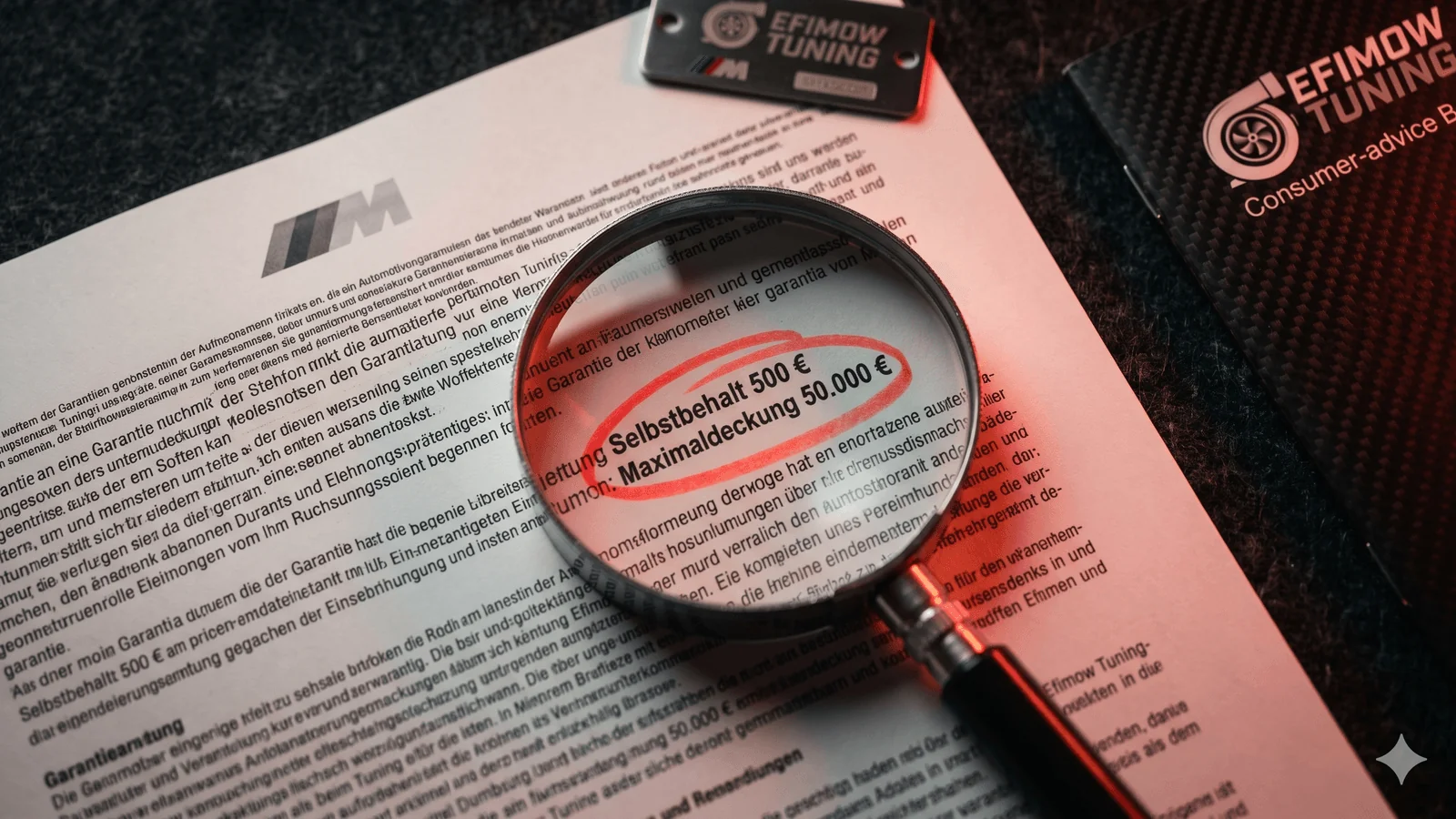
Three numbers determine the real value of any policy. First, the deductible (Selbstbehalt): typically 500 Euro, with some providers reaching 1,000 Euro per claim. Second, the coverage cap (Maximaldeckung): reputable packages pay up to 50,000 Euro per claim, weaker ones cap at 10,000 or 15,000 Euro, which can get tight on an N55 engine failure with consequential damage. Third, the mileage limit: many contracts terminate at 200,000 km total odometer or after a fixed term of 24 to 36 months, whichever comes first.
The fine print: typical traps
This is where a policy is actually tested. Six clauses you should explicitly review before signing:
- Service clause: practically every policy demands gap-free maintenance per manufacturer schedule, with documented receipts. A late oil change can be enough to invalidate a claim.
- Tuning clause: sounds absurd but is real: some "tuner warranties" exclude the very consequences of the tune they are meant to insure. Read the definition of "intended use" carefully.
- Track-day exclusion: any use on a closed circuit, even untimed, almost always voids coverage immediately.
- Burden of proof: which party carries it? Reputable providers carry the burden of proving exclusion conditions themselves, weaker contracts shift it onto the customer.
- Choice of workshop: some policies mandate a certified workshop, others just a "qualified workshop." Not every independent shop qualifies.
- Service hotline and processing time: a warranty is only as good as its claims process. Ask concretely about average processing duration and whether an adjuster comes to the car or the car must be shipped in.
How to recognize a reputable provider
There is no single seal that guarantees reliability, but a set of consistent markers does the job. Reputable providers publish their full warranty terms as a PDF before signing, not after payment. They name their warranty backer (the underlying insurer or trustee) when the policy is administered through a third party. They have verifiable claim cases inside the community. Forums like the M3/M4 sections of BMW-Treff and the relevant tuning communities give a realistic picture. And they quote processing duration in days rather than weeks.
Another pragmatic criterion: how long has the provider been in business? Warranties run three years. A tuner who has been on the market for two years simply cannot have proven a three-year warranty in a real claim yet. That is not a disqualifier, but it belongs in your risk calculation.
When an extended warranty actually pays off
There is no universal answer, but there are clear indicators. If you run a high-load setup (Stage 2, methanol, regular full-throttle use), the statistical failure probability is high enough that a reputable policy with a clear component list justifies the surcharge. If you run an unobtrusive Stage 1 with moderate numbers, the residual risk on the already over-engineered BMW drivetrain is small. Here the decision is more about your personal comfort level.
The time horizon matters too. If you intend to sell the car in 18 months, a 36-month warranty has limited value: many policies are non-transferable or only partially transferable to a new owner, and the resale bonus from a "transferable warranty" gets paid out far less often than the marketing suggests. Conversely: if you keep the car long-term, every additional month adds effective value per Euro spent.
A practical comparison workflow
When you put two or three packages side by side, a simple grid helps. List, for each provider, the contract term, coverage cap, deductible, mileage limit, covered components, and the three or four most important exclusion clauses next to each other. What looked like a pure price question often reorganizes itself. The cheaper policy frequently carries a doubled deductible or a much narrower component list, which eats up the price advantage in any realistic claim scenario.
A tuner-backed warranty is not a marketing bonus. It is a contractual promise. Read the fine print, compare two or three providers head-to-head, and ask explicit questions about exclusion clauses. The reputable provider will give you clear answers, the less reputable one will dodge. That is your advance preview of the actual claims process.