
The Physics Behind More Horsepower: P = M·n / 9550 Made Simple
Why every honest power gain means more torque or more RPM: the equation behind hp, Nm, and the marketing magic of manufacturer ratings.
May 6, 2026 by Leo Efimow
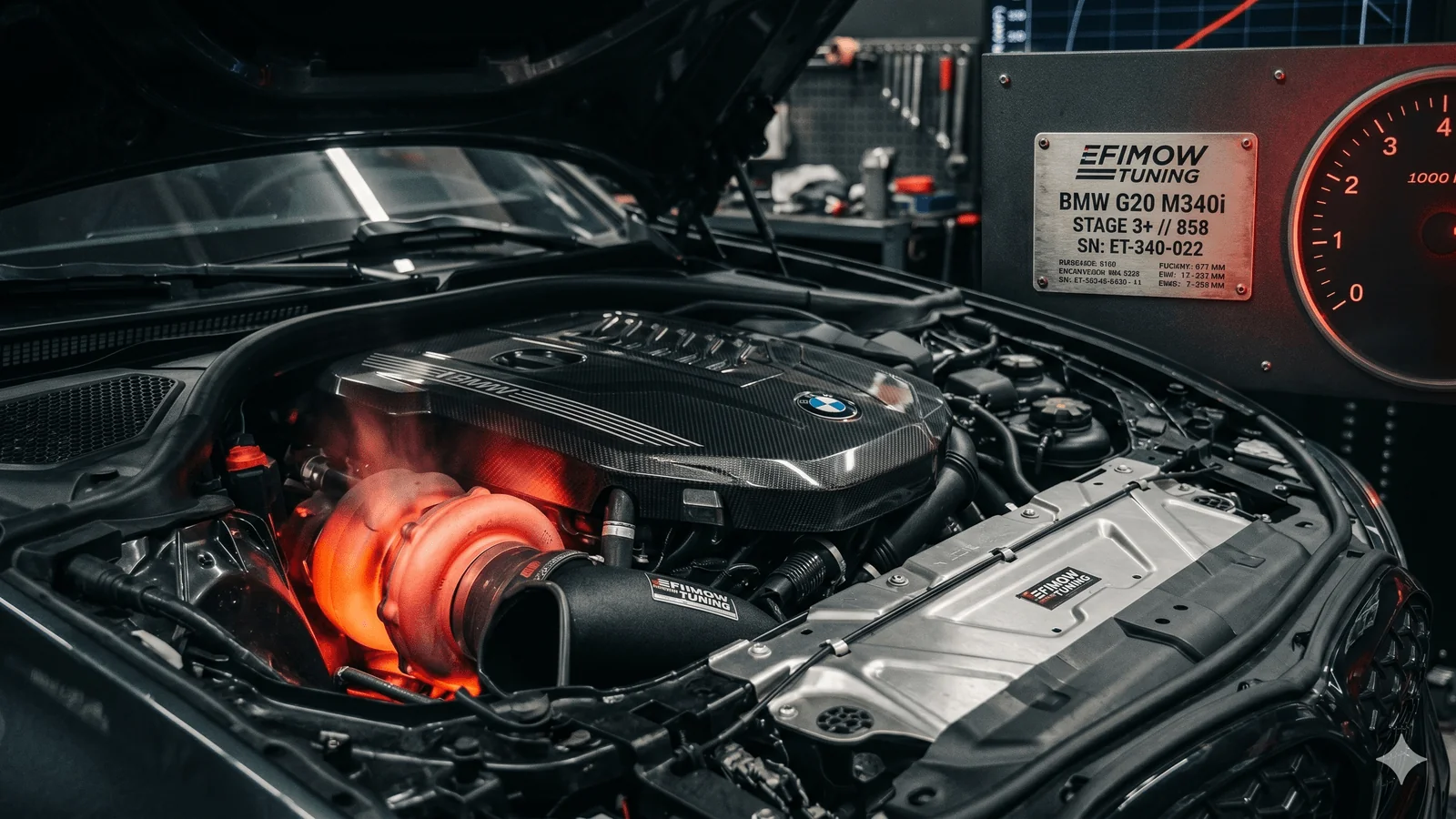
Roll onto the throttle in a BMW M340i at 80 km/h on the highway and something distinctive happens: the car doesn't wait until the engine is screaming near redline before it pushes. It shoves you back into the seat right now, at 1,800 RPM. That sensation isn't an accident. It's the result of one remarkably simple equation that ties torque, RPM, and power together, an equation that also explains why manufacturers can sell three different power ratings of the same engine, and why every honest power gain has to come from one of just two places.
The Equation: What Power Actually Is
Mechanical engineering uses a clean relationship for any internal combustion engine:
P [kW] = M [Nm] × n [RPM] / 9550
P is power in kilowatts, M is torque in newton-meters, n is engine speed in revolutions per minute. The 9550 constant is pure unit conversion: radians, seconds, and a factor of 60 collapsed into one number. To convert kW to horsepower, multiply by 1.36. Torque in pound-feet uses a parallel formula (hp = lb-ft × RPM / 5252), but the underlying physics is identical.
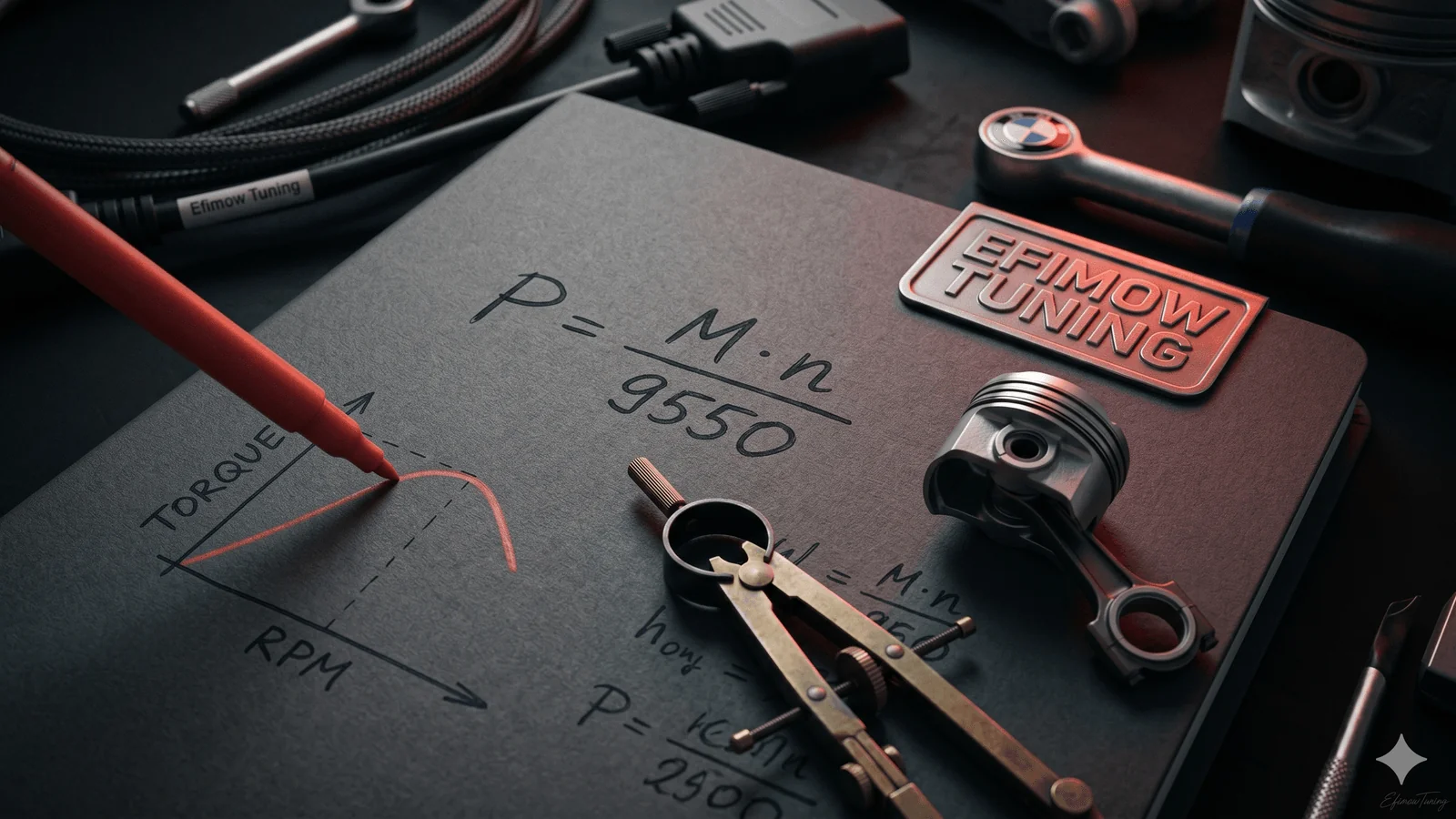
The consequence is provocatively simple: power is not its own quantity. It's the product of torque and RPM divided by a constant. If you want more power, you have exactly two levers to pull: torque, or RPM. There is no third option. Marketing language like "more horsepower through optimized airflow" is just a polite way of describing a movement in one of those two variables.
Torque itself is the force the engine exerts on the crankshaft, born from combustion pressure pushing the piston down. The clearest single number for "how hard is this engine pushing?" is brake mean effective pressure (BMEP): how much usable work the engine extracts per liter of displacement per cycle. Displacement, BMEP, and RPM together produce torque; torque and RPM together produce power.
Torque Plateau: Why Turbos Feel Different from Naturally Aspirated Engines
A classic naturally aspirated engine (the BMW S65 V8 in the E92 M3, for example) builds torque progressively as RPM climbs. Peak torque arrives around 3,900 RPM, peak power at 8,300 RPM. Down low there's not much torque on offer, so the driver has to wring the engine out to access its character. The whole personality is high-RPM-centric.
Modern turbocharged engines flip the script. The BMW B58 in the M340i (G20) delivers peak torque of roughly 500 Nm (about 369 lb-ft) starting at around 1,800 RPM and holds that torque as a wide flat plateau all the way to roughly 5,000 RPM. Only above that does it taper, while peak power of about 374 hp arrives near 5,500 RPM. That torque plateau is exactly why turbo BMW drivers describe the engine as "shoving from the basement": the turbocharger forces enough air into the cylinders that even at low RPM the engine burns plenty of fuel: high cylinder pressure, high torque.
Plug numbers into the equation and the effect becomes visible. At 1,800 RPM with 500 Nm:
500 × 1,800 / 9550 ≈ 94 kW (about 128 hp)
At 5,500 RPM with 480 Nm (slightly off-peak as the plateau starts to fade), the same engine produces:
480 × 5,500 / 9550 ≈ 276 kW (about 376 hp)
Both numbers come from the same engine, hardware, and software. The only thing that changes is RPM, and power follows RPM, because the torque plateau is already there. That's the heart of turbo character: lots of torque early, peak power only once RPM has had time to "translate" that torque into kW.
How Manufacturers Build Different Power Ratings from Identical Hardware
Open a BMW configurator and something striking jumps out. The B58 engine ships in several factory power tunes: 335 hp in the 340i, 374 hp in the M340i, 387 hp in the Z4 M40i, around 405 hp in some Toyota GR Supra variants, all with the same 3.0-liter displacement, hardware architecture, pistons, and turbocharger concept. How?
The answer falls out of the equation. Manufacturers have exactly three knobs to turn, and all three nudge the two variables in P = M·n / 9550:
| Lever | Effect in the equation | Real-world example |
|---|---|---|
| More boost pressure | raises BMEP → higher M | M340i runs higher peak boost than 340i |
| Higher RPM ceiling | raises n at peak power | Sport variants rev 200–400 RPM higher |
| Refined ignition / fuel timing | raises thermal efficiency → higher M | Software calibration |
Hardware-wise the engines are largely identical. What differs is the software: boost target maps, RPM limiter, ignition timing tables, torque limiter logic. The manufacturer is selling three things at once: hardware, a software configuration, and a marketing promise about the rev ceiling. That's also why credible software tuning on a B58 works so well: the hardware headroom is already built in, and it's the software that holds it back for warranty, insurance, and product-segmentation reasons.
What This Means for Tuning
If the equation only has two levers (torque and RPM), every honest power gain has to pull one of them. On a modern turbocharged engine like the B58, by far the most effective handle is torque, specifically BMEP via boost pressure. A modest bump from 1.0 to 1.2 bar of boost pushes roughly 20% more air mass into the cylinder. With matching adjustments to fuel and ignition timing, that becomes roughly 20% more torque in the plateau range. 500 Nm becomes 600 Nm; power follows through the formula.
The equation also exposes a less flattering truth: tuning that only lifts peak power has very little real-world value. An extra 50 hp that only lives between 6,000 and 7,000 RPM is something a daily driver will never feel. An extra 80 Nm between 1,800 and 4,000 RPM (the band where a G20 spends 95% of its life) is felt in every overtaking maneuver. That's why a serious dyno run publishes the whole torque and power curve and judges the tune on the area under those curves, not a single marketing figure.
The equation P = M × n / 9550 is more than a textbook line. It's the lens for reading every tuner's spec sheet, every press release, every "more horsepower" promise, and the only honest answer to "where does the power actually come from?".