
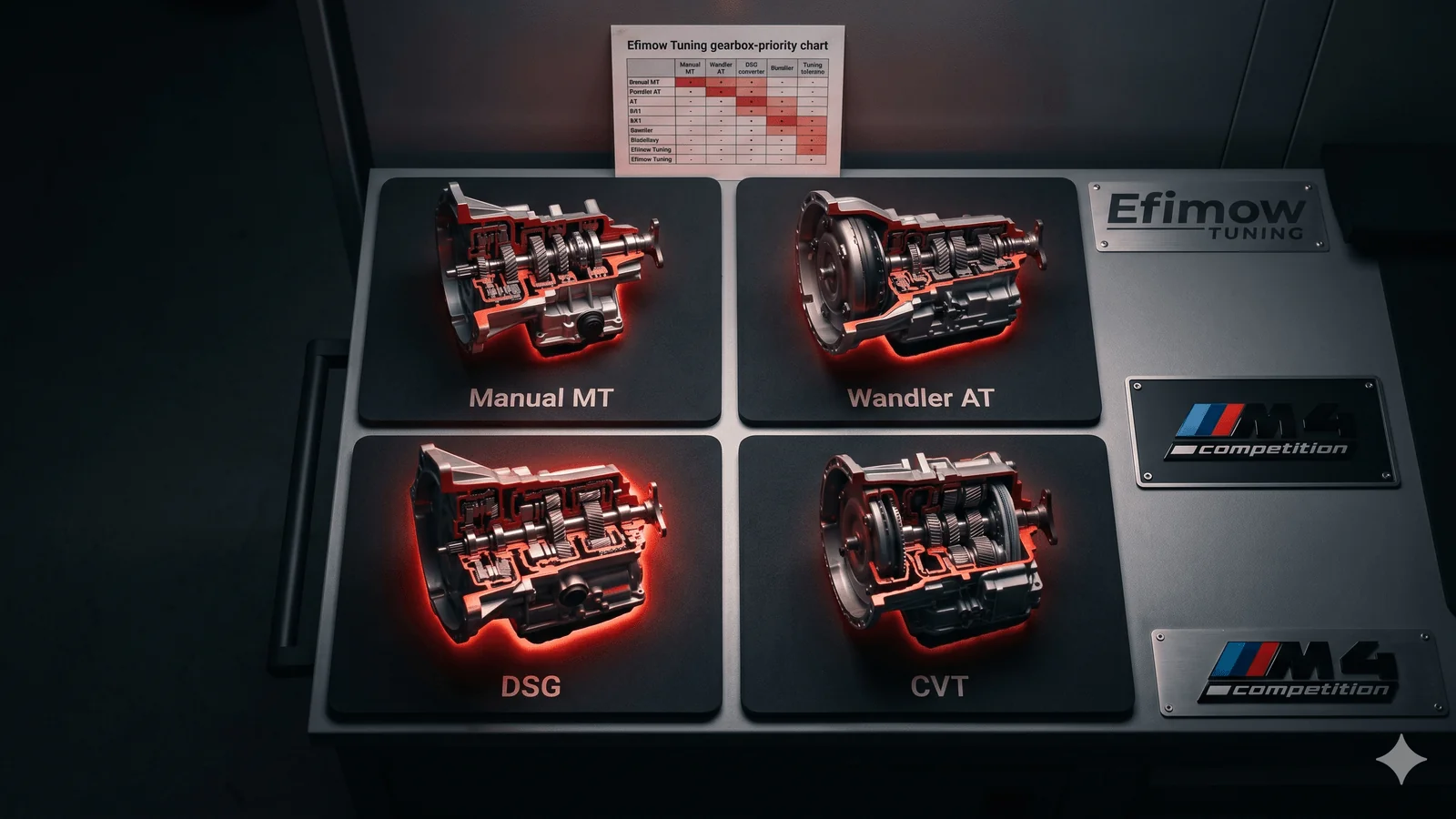
The Transmission as the Limiter: MT, AT, DSG, and CVT Compared for Tuning
It's often the gearbox, not the engine, that limits a tune. Which transmissions tolerate what, and why DSG tuning without a TCU re-flash is risky.
May 6, 2026 by Leo Efimow
When people plan a tune, they almost always think about the engine first: boost, fuel, ignition. But the engine is only one half of the drivetrain. The other half sits directly behind the flywheel and absorbs every additional newton-meter without a buffer: the transmission. In a surprising number of real cars, the first part of the drivetrain to reach its limit during a power increase is not the engine. It's the clutch, the torque converter, or the variator belt. That's exactly why it pays to ask, before any stage decision, what is actually bolted up behind the crankshaft.
MT: the Manual Gearbox and Its Clutch
On a classic manual transmission (MT), the gearbox itself is rarely the bottleneck. Gears, shafts, and synchronizers are usually generously dimensioned and tolerate elevated torque without obvious wear. The actual weak point is the clutch. A factory clutch is sized for the factory torque figure with a moderate safety margin. Once the torque peak rises significantly (a rough rule of thumb is roughly 20 percent over stock), the friction surface gets overwhelmed. The first visible symptom is slipping: engine speed climbs faster than road speed, especially in a high gear under full throttle.
Up to Stage 1, a factory clutch on a four-cylinder BMW manual usually still holds. From Stage 2 onwards, meaning roughly 30 to 40 percent extra torque, an upgraded clutch belongs in any honest cost calculation. On six-cylinder manual cars like the M2 or older M3 generations, the factory clutch is often borderline already at Stage 1, because base torque is high to begin with. Ignoring this buys an early shop visit and, in the worst case, a scored pressure plate or a heat-burned flywheel.
AT: the Torque Converter Automatic and Its Heat Problem
The classical torque-converter automatic (AT) tolerates considerably more than its reputation suggests. In modern BMWs the gearbox is almost always a ZF 8HP, an eight-speed converter automatic delivered in several torque classes. The ZF 8HP70 lives in many 3-Series and 5-Series cars, the ZF 8HP76 in stronger M Performance and M models, and the ZF 8HP90 even in V8 applications. Headroom on these gearboxes is high because BMW signs them off with substantial reserves to begin with.
ZF 8HP: Plenty of Headroom, but Not Infinite
Mechanical components in the ZF 8HP (planetary sets, friction packs, oil pump) are sized so moderate Stage 1 tunes typically run without hardware changes. The real limits sit in the torque converter and the cooling system. The converter has a lock-up clutch that engages at higher RPM; once it gets overwhelmed, it begins to slip and the transmission fluid heats up rapidly. At the same time the factory TCU (Transmission Control Unit) acts as a limiter: it carries a stored torque ceiling above which it stops increasing line pressure on the shift clutches. Without a TCU re-flash, the gearbox cannot cleanly absorb torque spikes, so the engine gets actively rolled back. The tuning effect evaporates exactly where it would matter most, namely at full throttle in the high gears.
From Stage 2 upward, a TCU update belongs to a clean concept: the torque ceiling is raised, the line-pressure curve is recalibrated, and shift timing is adapted to the new torque level. Without this step nothing wears out faster, but the car shifts unevenly, and part of the added power simply goes nowhere.
DSG: the Special Case with Two Clutches
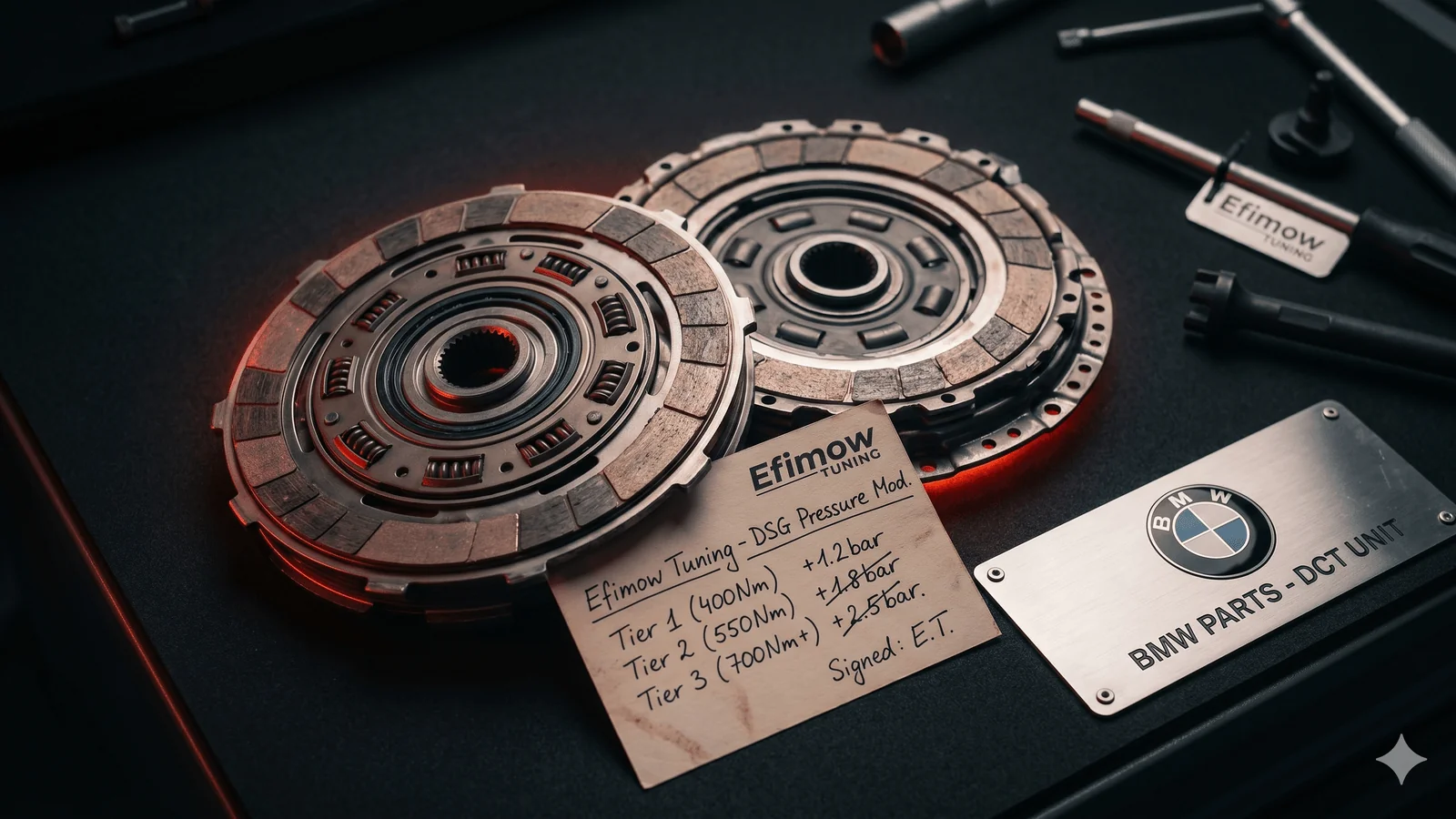
A DSG (direct-shift gearbox) sits in a different category. The DSG is not a converter automatic, it is an automated dual-clutch transmission, structurally closer to a manual than to an AT. Instead of a converter, two clutch packs run in an oil bath and alternate carrying torque. Those clutch packs are the thermal bottleneck. The DSG DQ500, used in stronger VAG applications, is rated for around 600 Nm in stock form: generous on paper, but heavily dependent on driving style in practice.
The decisive point: the DSG does not directly measure actual input torque. Instead it works from a torque model that the TCU derives from engine data. If the engine is power-tuned without telling the TCU, the TCU keeps clutch clamping pressure at the old reference. With higher real torque, the clutches start to slip on a microscopic level. Every shift event creates extra heat, the oil ages faster, the friction surfaces polish. After a few thousand kilometers this shows up as harsh shifts, low-RPM judder, or in extreme cases as a limp-mode event. A DCT dual-clutch in BMW M models follows the same logic.
A DSG tune without a TCU re-flash is therefore reckless. The TCU must know the new torque level, raise clamping pressure accordingly, and ideally rework the shift schedule. Only then does the system run inside its design envelope and not in the regime where clutches slowly burn.
CVT: the Continuously Variable Transmission as a Fragile Component
A CVT (continuously variable transmission) tolerates the least. Instead of fixed ratios, a CVT uses two pairs of variable pulleys connected by a steel belt or a link chain. Transferred torque depends directly on friction between belt and pulley, and friction depends on clamping pressure. Raise input torque noticeably without raising clamping pressure, and the belt starts to slip on the pulleys. Unlike a friction clutch, this damage is not repairable; the variator belt is destroyed, often together with the pulley faces themselves.
CVT is not used in BMW models, so this matters here only as a comparison: in many midsize Japanese models that ship with a CVT, even moderate torque increases are critical. A serious tune on such a vehicle usually requires a converter or DCT swap. A software-only path barely exists.
What This Means for Stage Planning
The right order is therefore not "engine first, transmission once it complains," but the opposite: what's bolted up behind, and how much torque does it tolerate from the factory? On a 3-Series with a ZF 8HP and Stage 1, a TCU update is usually the right step before going to Stage 2. On a manual M2, the clutch is on the table sooner. On any dual-clutch car (DSG or DCT), the TCU re-flash belongs in the software package by default; otherwise a hidden wear problem builds up that only surfaces months later. The transmission is not the brake on the drivetrain. It is the indicator of whether a tune was planned through cleanly, or whether someone stopped thinking once the engine map was done.