
Spark Plugs and Filters: What to Check More Often After a Tune
Higher boost means higher misfire risk. Which maintenance items should be checked more often after Stage 1, and which factory intervals still hold.
May 6, 2026 by Leo Efimow
A Stage 1 calibration shifts your engine's thermal and mechanical loads noticeably upward. More boost, more fuel, more advance: all of it eventually lands in the combustion chamber, right where the spark plugs, air filter, and fuel filter live. The tune itself is clean if it's calibrated properly. What changes is how often the wear items deserve a look. If you carry the factory service intervals straight over from the booklet, you're inviting misfires, power loss, and in worst-case scenarios follow-on damage that costs far more than a fresh set of plugs.
The good news: you don't need a brand-new maintenance plan. You just need to know which three components deserve a tighter cadence after a tune, and how to recognize when a visual inspection beats a fixed mileage number.
Why Tuning Shifts the Service Window
A BMW B58 or N55 in stock form runs with comfortable margins. The plug sees typical insulator-tip temperatures of 900 to 1,560 degrees Fahrenheit (500 to 850 Celsius), the air filter sees a flow rate matched to factory mapping, and the fuel filter only sees the injection volumes the stock map allows. Once Stage 1 is active, all three of those numbers climb at the same time: higher cylinder pressures, more air mass per stroke, and longer injection durations or higher rail pressures.
That's perfectly durable as long as the components stay inside their design envelope. But the envelope shrinks. A lightly contaminated air filter that would coast through four more inspections on a stock car starts measurably restricting flow on a tuned motor. A plug with 16,000 miles on it that runs flawlessly stock can throw early misfires under tuned load near redline. Those aren't defects. Those are parts running at the upper edge of their tolerance band.
Spark Plugs: the Most Critical Item
The spark plug is by far the most sensitive wear point after a tune. Two things to understand here: heat range and replacement interval.
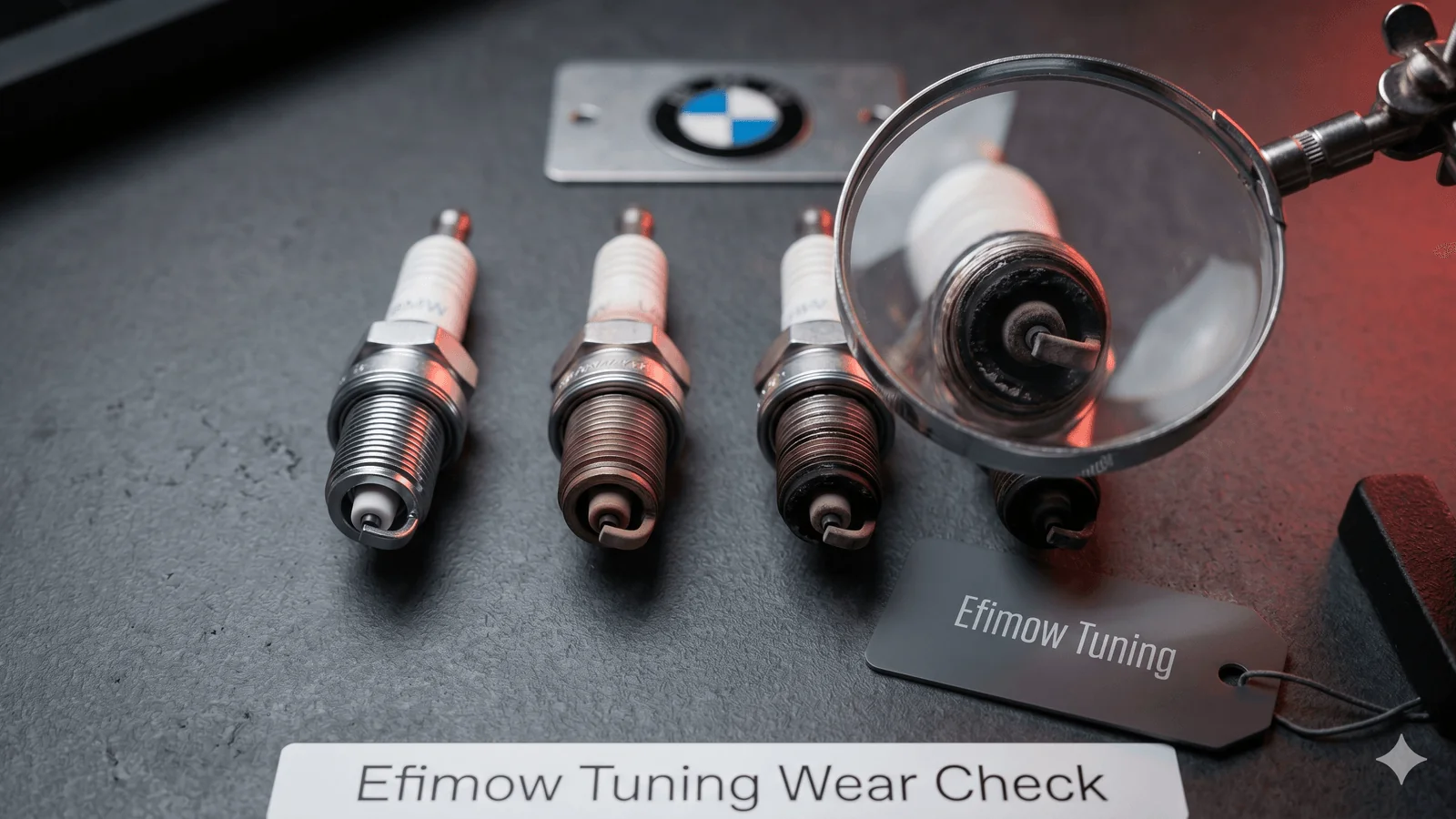
Heat range describes how quickly the plug transfers heat away to the cylinder head. NGK uses higher numbers for cooler plugs, and Denso follows the same convention. Counterintuitive at first, but worth memorizing. In the B58, BMW factory-fits the NGK ILZKAR8H7G, a heat range 8 plug on the NGK scale. For a moderate Stage 1 power level, that plug typically stays within spec. For Stage 2, higher boost targets, or aggressive full-throttle use, we recommend stepping to a plug exactly one heat range cooler; on the B58, typically an ILZKAR9H7G or its Denso equivalent. One step, not two. Going too cold invites cold-start fouling and carbon buildup at part-throttle.
Replacement interval: BMW publishes 60,000 to 100,000 miles for most modern turbo engines. On a tuned engine, we cut that in half. Practically, that means every 18,000 to 25,000 miles you pull them, look at them, gap them, and replace them if there's any doubt. A set of plugs is nothing compared to a destroyed catalytic converter from sustained misfires. On visual inspection, watch for electrode gap, white deposits on the insulator (a sign of a lean condition or excess heat), and sooty buildup (rich, cold, or wrong plug type entirely).
Air Filter: Clean Air, Happy Turbo
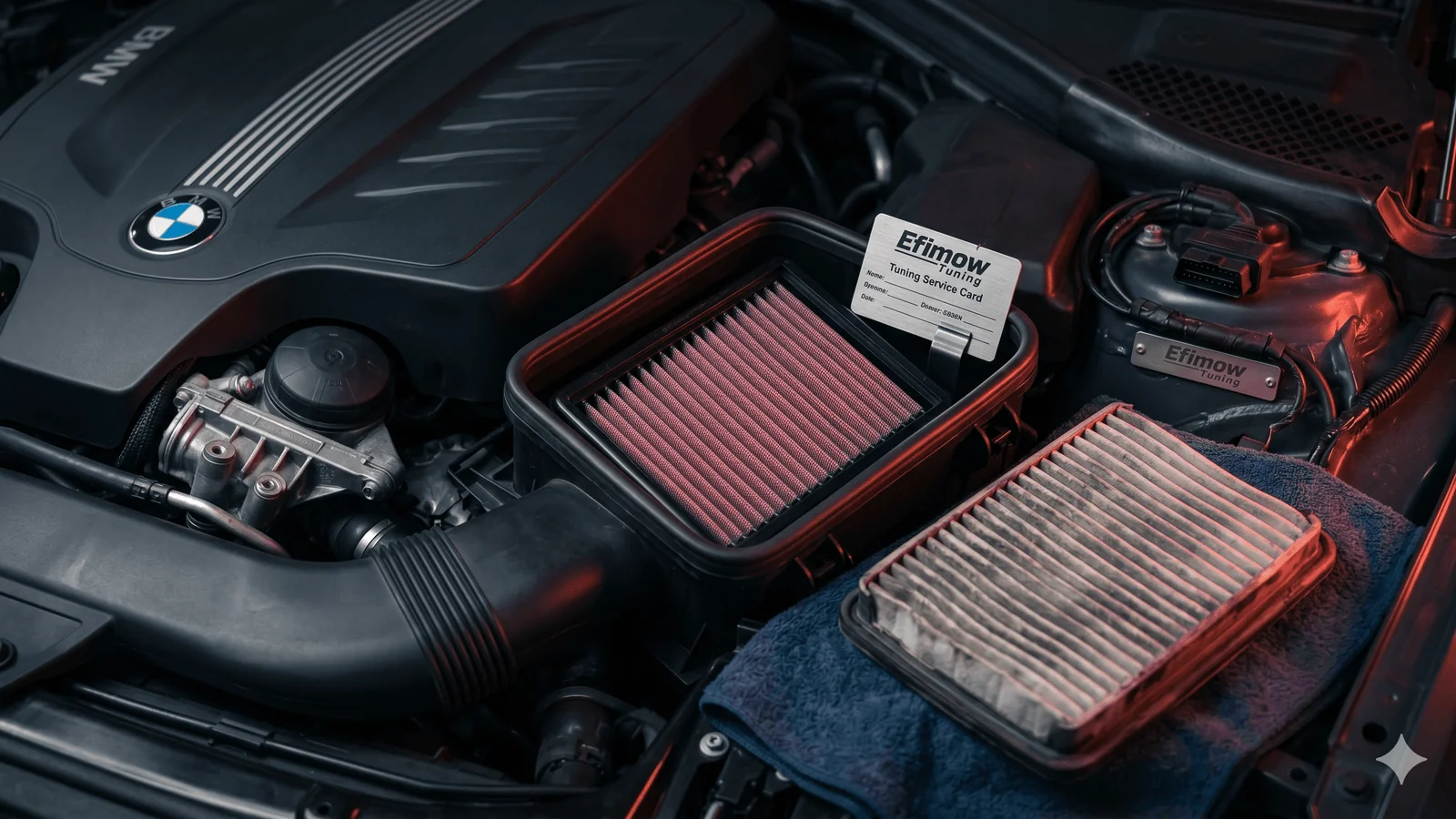
The air filter is the second most common source of unexplained power loss after a tune. A clogged filter creates higher vacuum at the turbo inlet, the compressor works harder to hit the requested boost, and intake air temps climb. The ECU sees that, the knock sensor reacts, and adaptation pulls timing. Result: you feel less power without a single fault code in the memory.
Factory BMW interval is roughly 37,000 miles or four years. On a tuned car that actually gets driven, inspect every 12,000 miles at the latest. A visual check is enough in most cases: pull the element, hold it up to a light, judge how loaded it is. Even gray dusting is fine, dark patches or insect debris on the pleated face means replace. If you've gone to a washable performance filter, inspect more often and clean per the manufacturer's instructions. K&N and similar brands publish cleaning schedules. Follow them, otherwise oil migrates onto the mass-airflow sensor and skews the signal permanently.
Fuel Filter: Especially on Diesels
On gasoline engines the fuel filter plays a minor role, since it usually lives inside the tank and is rated for the engine's life. On diesels it's a different story. The external filter on BMW diesels (B47, N57, B57) is a service item with a clear replacement interval, typically every 37,000 miles. After a tune, both injection pressure and injection volume rise, the filter sees more volume per mile, and it ages accordingly faster.
Cut that interval in half too. A clogged diesel filter causes pressure drop at the high-pressure pump, the ECU reduces injection, and worst case the car drops into limp mode. On common-rail systems the high-pressure pump is an expensive part, and the filter is the cheapest insurance policy you can buy for it.
Visual Inspection Beats Fixed Intervals
The most important point to close on: on a tuned engine, visual inspection matters more than the odometer. If you use the car hard at full throttle, drive a lot of short trips, or live somewhere dusty, fixed intervals won't keep up. Build yourself a simple rhythm: at every oil change pull the air filter and look at it, every second oil change measure the plugs, and on diesels run the fuel filter alongside the regular service.
This isn't paranoia. It's the logical consequence of running the engine outside its factory envelope. The margins BMW engineered in are smaller after a tune. Your maintenance discipline closes that gap.
One last note on the torque wrench: when changing plugs on a B58 or S58, the specified torque value matters precisely. BMW calls for between 23 and 28 Newton-meters (roughly 17 to 21 lb-ft) depending on the engine. Over-torqued plugs damage the aluminum head's sealing face; under-torqued ones lose compression and in rare cases get blown out under full load. A basic torque wrench with a clearly marked scale is cheap and belongs in any tuning enthusiast's toolbox if you handle service yourself. If a shop does the work, ask the technician whether they're using a wrench. On modern turbo engines that's not a detail, it's a safety item.