
What Is an ECU? The Nervous System of a Modern BMW Engine
The ECU (BMW: DME) is the central control unit of every modern BMW: what it does, why it processes hundreds of sensors in real time, and why tuning starts here.
May 6, 2026 by Leo Efimow
When people say "chip tuning" today, they almost never mean chips anymore. The component that everything actually hinges on is the ECU: Engine Control Unit, which BMW has historically called the DME (Digital Motor Electronics). It is not a passive control device; it is a fully programmable computer that decides, millisecond by millisecond, exactly how much fuel goes into each cylinder and when ignition fires. On current BMW G-platform models that role belongs to a Bosch unit from the MG1 or MD1 family (designations like MG1CS003, MG1CS024, or MG1CS201), built around an Infineon TriCore Aurix microcontroller with multiple processor cores. If you want to understand the engine, you eventually have to understand this box.
How the ECU Manages the Engine
The ECU usually lives in the engine bay or under the windshield and is connected to the rest of the vehicle via CAN and FlexRay buses. On the input side, it receives data from well over a hundred sensors: crankshaft and camshaft position, manifold pressure, boost pressure, lambda values before and after the catalyst, knock sensors on each cylinder, temperatures at oil, coolant, intake air, and gearbox oil, throttle pedal position, steering angle, wheel speed, and many more. Analog signals are digitized through onboard analog-to-digital converters before they enter any calculation.
From this data stream, the microcontroller calculates, several thousand times per second, what should happen at the actuators: injectors open for a precise duration in microseconds, spark plugs fire at a defined crank angle, wastegate and bypass valves on the turbocharger control boost, the throttle actuator follows the pedal with subtle corrections that the driver does not consciously notice. A real-time operating system (RTOS) underneath ensures every one of these tasks lands deterministically inside its allotted time window. On a four-cylinder spinning at 6,000 RPM, that means 200 ignition events and 200 injection events per second, each one calculated individually, each one monitored individually.
The logic behind all of this lives in maps: multi-dimensional tables that assign a target output to a given combination of inputs. For example: at 3,000 RPM, 1.2 bar of boost, and 28 °C intake air temperature, fuel quantity should be X and ignition angle should be Y. A modern BMW ECU contains hundreds of such maps: for fuel, ignition, boost target, torque request, lambda regulation, deceleration cutoff, and dozens of other functional areas.
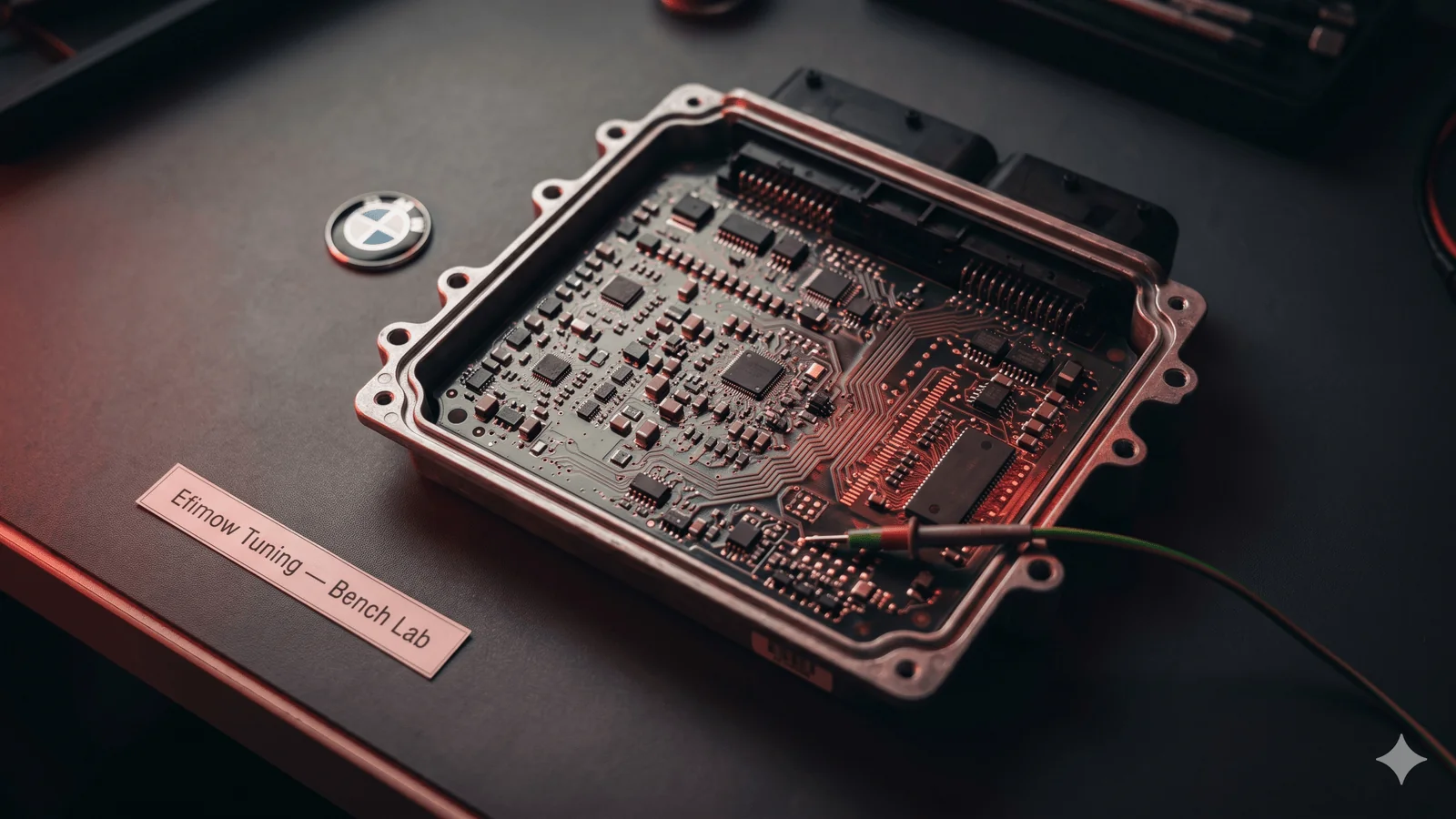
This is exactly where any serious software tune intervenes: not by tricking individual sensors, but by deliberately changing the values in those tables, within the envelope the hardware already provides anyway.
Why the Manufacturer Deliberately Leaves Headroom
If the ECU regulates every operating point this precisely, why does the factory calibration leave any room for optimization at all? There are four reasons that all act simultaneously.
Global fuel quality: A BMW engine has to run on fuel from Riyadh just as reliably as on fuel from Hamburg. The factory calibration commits to the worst expected case, often 91 RON or worse. In Germany on premium 95 or 98 octane, this leaves a safety margin that essentially never gets used in everyday driving.
Climate and altitude headroom: The engine has to perform reliably at +45 °C in Dubai, at -25 °C in Scandinavia, and at 3,000 m in the Andes. Here too, the calibration is deliberately conservative, because the factory map has to cover every one of those edge cases without a special release.
Long-term durability: The factory tune must hold for 200,000 km even when the owner stretches service intervals or runs the car mostly cold and on short trips. That keeps thermal and mechanical load on components like the turbocharger, high-pressure fuel pump, and piston rings well below what a hotter calibration would impose.
Market segmentation: The same 2.0-liter B48 four-cylinder runs with differently calibrated software depending on the badge, from 184 hp in a 320i to 245 hp in a 330i. The hardware difference is often minimal: same block, same pistons, in many cases even the same turbocharger. The rest is a software decision by the manufacturer, made in the calibration table, not at the engine itself.
What ECU Access Actually Means Today
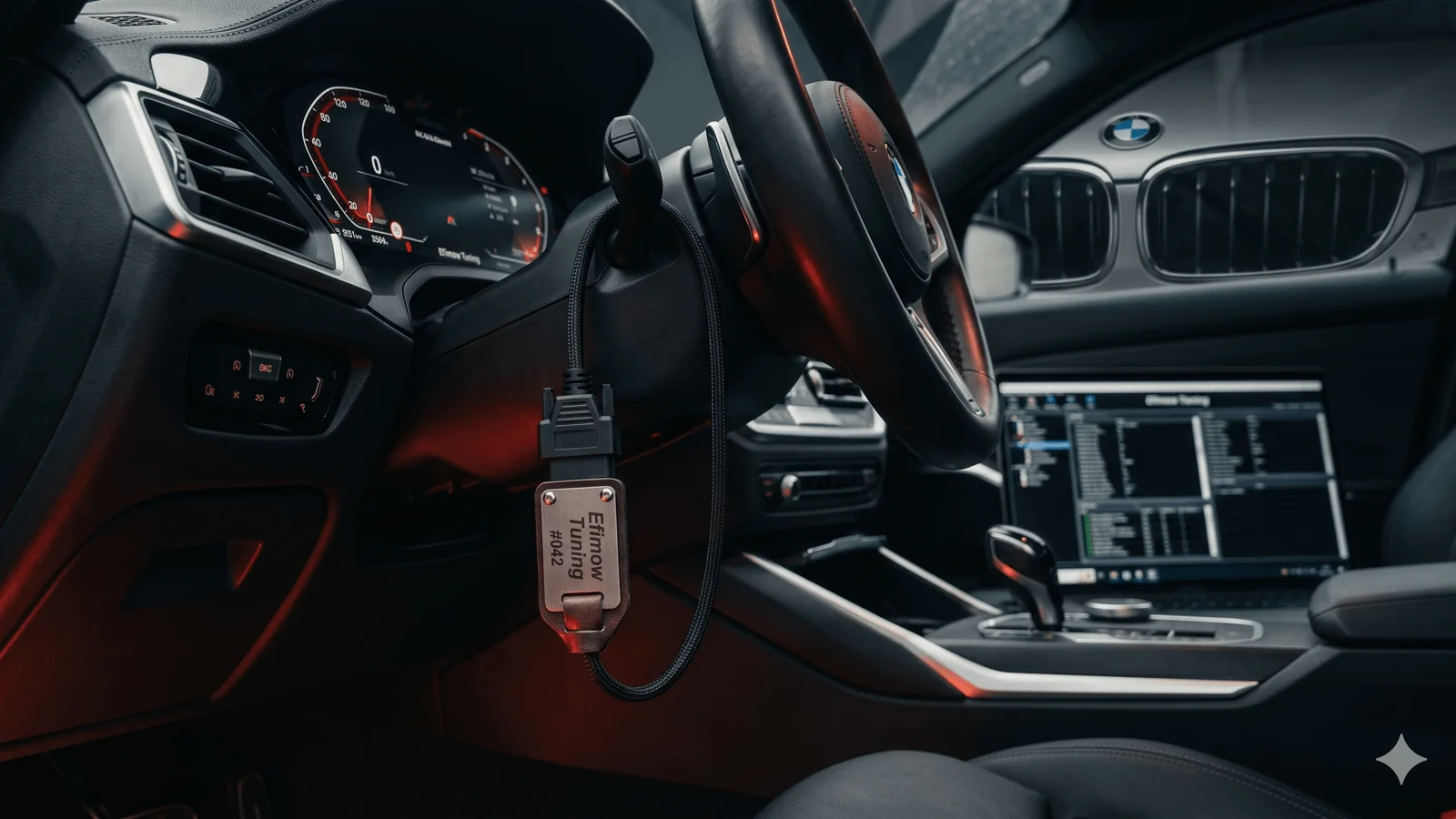
Until the early 2000s, modifying a control unit meant physical work: open the housing, desolder the EPROM, fit a new chip. Hence the term "chip tuning." Today this is almost always a software process. The ECU is read out through the OBD-II port, modified on a laptop, and flashed back, provided the manufacturer has not enabled write protection. With BMW, this has increasingly been the case from the G-platform onwards, June 2020 and later: the Bosch units in the MG1 and MD1 families enforce digital signature verification and use multi-stage bootloaders (SBOOT, CBOOT), which is why bench mode or boot mode is often required there, meaning direct access on the removed control unit.
Whether OBD, bench, or boot mode, the principle stays the same: the work changes the table values that the ECU calculates against, not the hardware itself. The protection routines stay active. If a knock sensor reports a combustion anomaly, the ECU can pull ignition timing and reduce boost on the spot, even after a tune, provided the software was done professionally. The closed-loop control still runs: sensor → calculation → actuator → measurement of the result → correction. A tune shifts the targets inside that loop; it does not bypass the loop.
This is the core reason why software tuning on a modern ECU can be technically safe. Not because the engine suddenly tolerates more than before, but because the safety net of sensors and protection logic still works. As long as the tuner adjusts the maps with judgment and measured data, and not just the numbers a customer would like to see.
Bottom Line
The ECU is not an engine part that liberates more or less power on its own. It is the logic layer that decides how close the engine operates to its hardware limits. Factory software stays well below those limits for good reasons: fuel tolerances, climate extremes, the 200,000-km mandate, model segmentation. A professional software tune moves that line a bit closer to the hardware ceiling, within what the components are already capable of delivering. Once you understand that, you understand why "chip tuning" today has less to do with chips than with data analysis, instrumentation, and a very careful look at the right tables.