
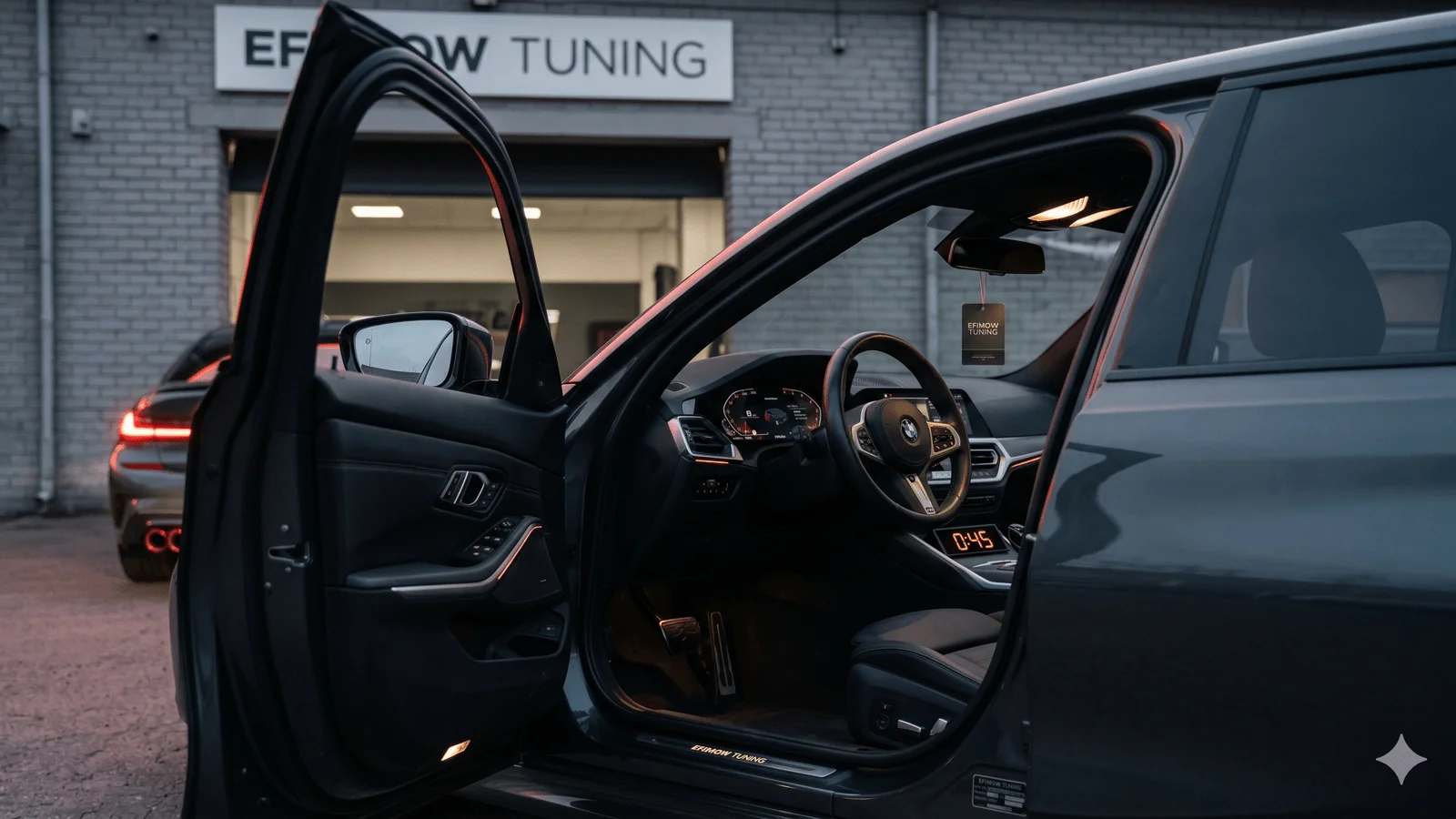
Warm Up and Cool Down: The Single Most Important Rule for Turbo Engines
Why 30-60 seconds of idle after a highway run can save your turbo, and how cold full-load starts wreck bearings and compressor wheels.
May 6, 2026 by Leo Efimow
There are few rules in a modern turbocharged engine that hold genuinely universally, and warming up and cooling down belong to that short list. Follow them, and the bearing-pack life of your turbo multiplies. Ignore them, and the damage rarely shows up immediately, but it accumulates: in microscopic traces on the bearing surfaces, in dark coke residue around the shaft, in a slow degradation of spool behaviour. On a tuned BMW (be it a B47 with raised injection quantity, a B58 with extra boost headroom, or an S58 already close to the factory ceiling), the load shifts further toward the bearing's limit. That is exactly why this is not a "nice extra for enthusiasts" but a hard requirement.
Why turbo shaft speeds are brutal
The clearances inside a modern turbocharger are extraordinary: the central shaft connecting the compressor and turbine wheel spins at 150,000 to over 300,000 revolutions per minute at full load. That shaft rides on a thin oil film between so-called floating bushings, a fully oil-supported bearing with no mechanical contact in the ideal case. As long as the oil film holds, the shaft "swims" hydrodynamically and wear stays minimal.
If that film breaks down (through oil that is too cold and viscous under load, or through subsequent coke deposits at the bearing surfaces), bearing damage develops within seconds and leaves visible traces by the next full-load run. The turbo grows louder, spool behaviour gets ragged, and in advanced cases oil weeps through the shaft seals.
Cold start and full load: two enemies that do not mix
When the engine is cold, the coolant is not the only thing well below operating temperature; the engine oil is too. With a typical 5W-30 or 0W-20, viscosity right after start is several times higher than after ten minutes of driving. That high viscosity means oil flows more slowly through the fine channels of the turbo bearing, the hydrodynamic film takes longer to build, and the oil pump itself moves less volume at low temperature.
Asking for full load in this phase demands the bearing's maximum before the lubrication system can deliver it. The result is measurable micro-erosion on the bearing surfaces, and on a tuned engine with raised peak torque, the process accelerates. The rule of thumb: no full load until at least half operating oil temperature (around 60 °C). Modern BMW instrument clusters can show oil temperature directly on the on-board display; on older models, coolant temperature works as a rough proxy, with the caveat that oil typically lags coolant by a few minutes.
End-of-hot-run: the underestimated risk
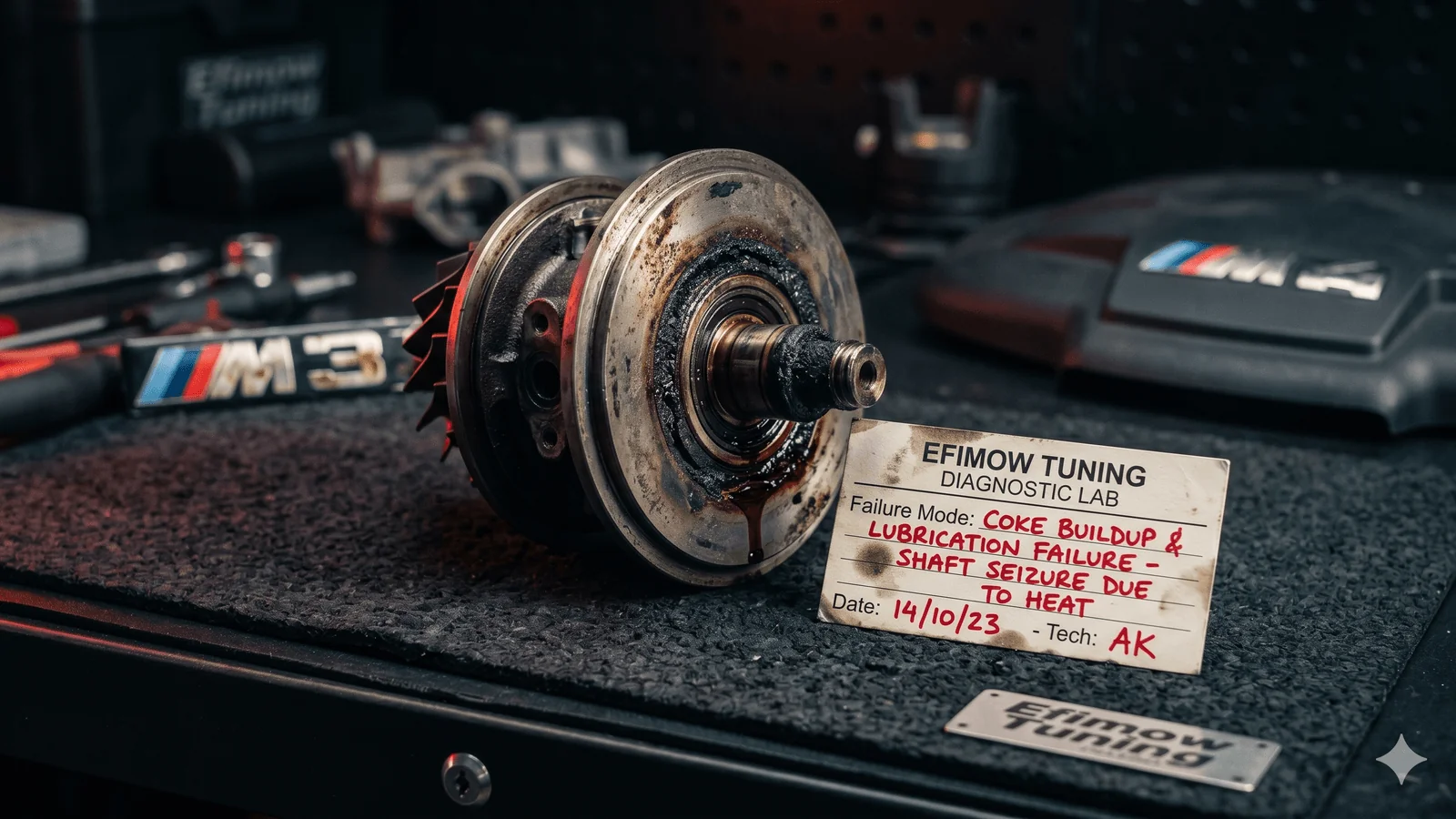
The mirror image of the cold start is shutting the engine off abruptly after a hot run. A long Autobahn (German motorway) stretch, a mountain pass under load, or a track session brings the turbine side of the charger to 800–950 °C. Cut the engine in that state and oil circulation stops instantly, but the shaft does not. It coasts down. The oil left in the bearing is heated further by the residual mass of the turbine housing, can boil locally, and in a process that workshops call "Verkokelung" (oil coking) is converted into hard, carbon-like residue.
These coke deposits settle on the shaft and inside the oil-feed galleries. On the next cold start they act as additional friction partners: film build-up is delayed, the shaft seals are loaded mechanically, and the damage propagates. After enough cycles bearing wear is bad enough that the turbo has to be replaced, a four-figure expense on a modern mono- or bi-turbo system at B58 or S58 level.
The 30-to-60-second rule
The fix is trivial in effort and enormous in effect: 30 to 60 seconds of idle after a hot run before shutting the engine down. During that window the oil pump keeps feeding the bearing, the turbine housing cools aerodynamically and through the continued exhaust flow, and the shaft comes to rest under continuous lubrication. In practice:
- after city driving: usually no extra wait needed, since charger temperatures stayed low
- after moderate country-road driving: 15–30 seconds is enough
- after an Autobahn stretch (cruising speeds, longer full-load phases): at least 30 seconds, ideally 60
- after trackday or alpine passes: 60–90 seconds depending on intensity
On modern BMW models with auto start-stop, the rule still applies: the DME (Digitale Motorelektronik, the digital engine controller) hot-run logic delays automatic engine-off when charger temperature is high, but a deliberate idle phase is the safer option.
Why tuning makes this more important
A power upgrade shifts three parameters simultaneously: higher boost, higher exhaust gas temperature, and depending on configuration higher compressor shaft speed. All three increase the thermal load on the bearing and therefore the coking risk on abrupt shut-off. The 60-second rule is a comfort detail on a stock car; on a tuned car it becomes the primary wear-protection measure.
A second point: tuning demands uncompromising oil discipline. The extended drain intervals manufacturers permit on stock duty are problematic on a tuned engine. We recommend customers running Stage-1 or Stage-2 software a drain interval of 10,000 to 15,000 km with a high-quality fully synthetic oil to the correct OEM specification (for example BMW LL-04 on most B-series engines).
A practical routine for the tuned BMW
Putting the rule into daily practice is easier than it sounds:
- Arriving at your destination after a fast leg: do not switch off immediately. Let the engine idle while you grab the bag from the trunk or finish the last call.
- At fuel stops: same principle. The engine is still running while you pay, and the charger is properly cooled by the time you drive off.
- On cold starts: the first 5 kilometres at moderate load, shift up early, no full throttle until oil shows operating temperature.
- On occasional track or sport sessions: give the charger an explicit cool-down lap at idle directly after the stint.
Bottom line
The turbocharger is one of the most highly-stressed components in a modern engine. Its lifespan does not come down to luck but to two simple behavioural rules: no full load before operating temperature, no immediate shut-off after full load. Anyone who follows them and changes their oil on time runs their tuned BMW through the full hardware lifespan without bearing drama. Anyone who ignores them eventually pays for the convenience the rule cost them.