
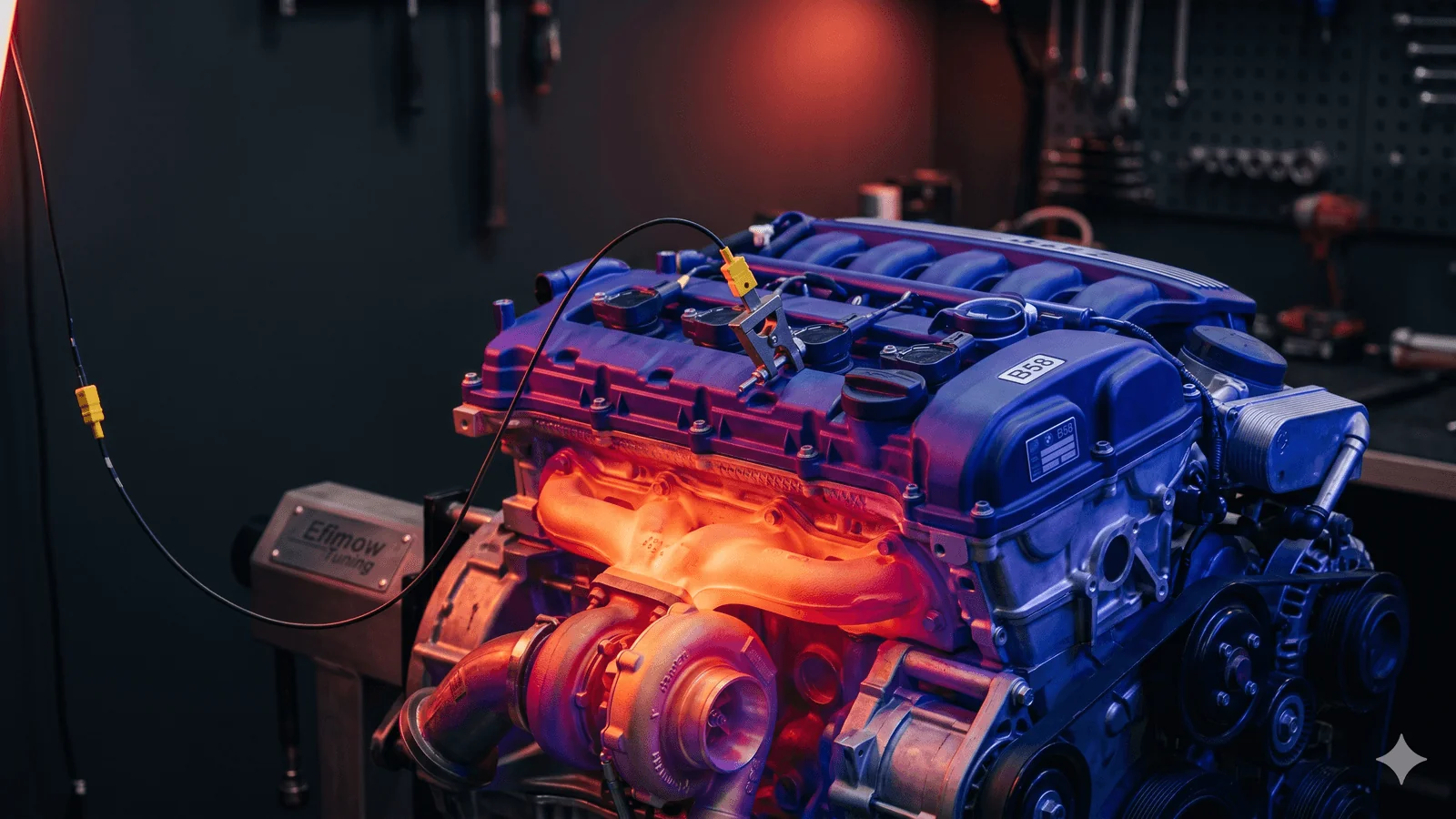
Thermal Headroom and Limits in Chip Tuning
How much heat a BMW engine can take, where the factory headroom ends, and what happens when bad software pushes past those limits.
May 6, 2026 by Leo Efimow
More power always means more heat. Every extra horsepower comes from burning more fuel, and a sizable share of that energy ends as heat, not motion. A Stage 1 or Stage 2 calibration buys not just torque but additional thermal load on the combustion chamber, exhaust valves, turbocharger, and intercooler. The difference between software that runs cleanly for decades and software that fails after the first hot summer almost always lives here: how much factory headroom is consumed, and whether anything is left for mountain runs or August trailer hauls.
Why More Power Means More Heat
Inside the combustion chamber of any turbocharged BMW, from B47 diesel to S58, peak temperatures per cycle hit 2,000-2,200 °C (3,600-4,000 °F). That peak lasts a fraction of a millisecond; the burnt gas then mixes with fresh charge, expands into the exhaust manifold, and cools sharply. What stresses components is not the peak but the mean thermal load: how hot the exhaust valves run continuously, how hot the turbine glows, and how much heat the cylinder head hands off to the coolant.
These means shift with every power increase. When a B58 runs 1.6 bar (~23 psi) of boost instead of 1.2 bar, energy per stroke climbs roughly 25-35 percent. With it rise the EGT, heat flux into the head, coolant pump load, and intercooler demand. The factory headroom is real but finite.
That headroom is not generosity. It exists because the car must cope with conditions rarely seen in daily driving: 40 °C (104 °F) ambient in southern Italy, a 2,000 m (6,500 ft) pass in thin air, a loaded wagon towing in mid-summer. The factory calibration must cover all of those, and that buffer is precisely what separates serious tuning from sloppy tuning.
The Critical Components: What Actually Fails
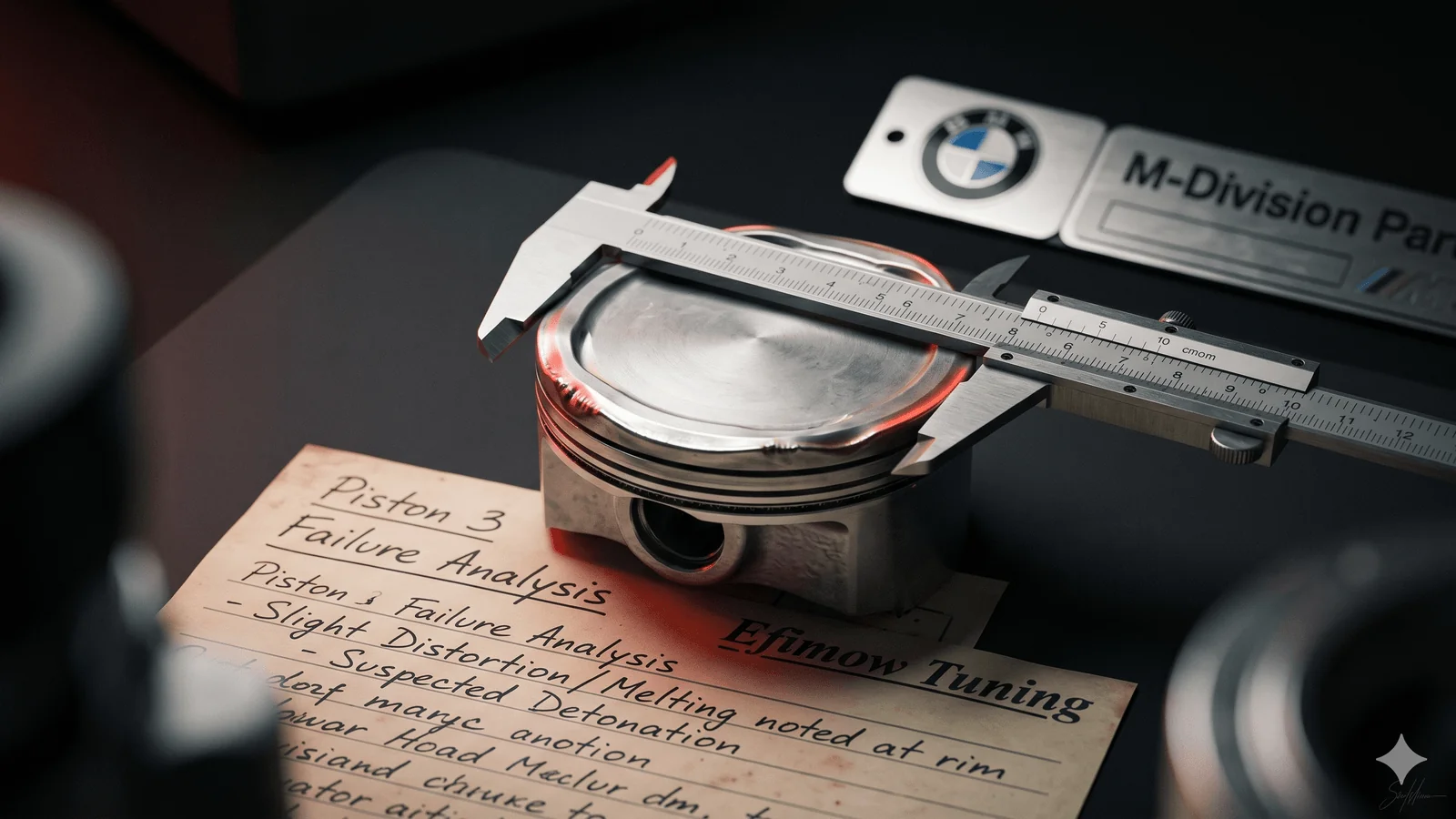
When software exceeds its limits, "the engine" does not fail diffusely. One specific component fails first, always one of the same suspects. First, the pistons: the aluminum alloys in the B48, B58, and N57 melt around 660 °C (1,220 °F), and the alloy softens well before that, with strength dropping above 350-400 °C. A combustion event that runs too rich or fires too early creates hotspots on the piston crown, and the next round of knock cracks the weakened material open. The damage typically looks like a ragged funnel with melted edges. Not a clean fracture, but a melted opening.
Second, the exhaust valves, which sit permanently in the hot exhaust stream and shed heat only through the seat; rich mixtures or retarded ignition make them glow red, distort, or burn. Third, the head gasket and cylinder head: a poorly designed Stage 2 with high peak pressure and weak charge-air cooling produces thermal stress between block and head, leading to coolant in the oil or cracks into the water jacket. Fourth, the turbocharger: the turbine normally glows red to orange, which is fine, but under sustained EGT overload the blades go brittle, the bearing housing distorts, and the first symptom is oil leakage at the shaft seals.
EGT: The Most Important Number You Never See
EGT stands for Exhaust Gas Temperature, measured directly upstream of the turbocharger. It is the most reliable early indicator of thermal trouble, and for that reason essentially never shown on a stock BMW cluster. The ECU models it internally, slips into protection mode at threshold, and pulls boost or fuel without telling the driver.
The orders of magnitude are clear. A modern BMW diesel (B47, B57) should not run continuously above 820-850 °C (1,500-1,560 °F) under full load; beyond 950 °C (1,740 °F) things get critical. A modern BMW gasoline engine (B48, B58, S58) tolerates more thanks to the Otto cycle's character; 950-1,000 °C (1,740-1,830 °F) is where serious tuners draw the red line, and 1,050 °C+ is where blades and manifolds take damage.
The difference between a good and a bad Stage 1 is an EGT delta of 30-80 °C versus stock at identical power. A clean calibration produces the gain with moderate boost and a clean combustion phase; a sloppy one extracts it via retarded ignition or rich mixture. Both feel the same at first. Three years and 60,000 km later the difference is worth a workshop bill.
When the Intercooler Becomes the Limit
Charge air leaves the turbocharger hot: on a B58 at 1.6 bar, typically 130-160 °C (265-320 °F). The intercooler must bring that down so air enters the combustion chamber at maximum density; cooler air means more oxygen per liter, better combustion, and less knock. A reasonable design lands the intercooler outlet in steady-state at 15-25 °C above ambient, with peaks under full load up to 50 °C above ambient.
This is where the Stage 1 to Stage 2 transition sits. A Stage 1 stays inside the factory cooler's envelope; a Stage 2 calls for additional hardware (a larger core or a water-to-air loop), because otherwise the throttle-plate inlet temperature climbs high enough that the ECU starts pulling timing. A Stage 2 without an intercooler upgrade effectively delivers a richer Stage 1 in summer, the moment intake air gets too warm.
What Is BMW-Specific
Thermal characteristics differ noticeably between BMW engine families. The B58 is the most thermally robust of the modern straight-sixes; a closed-deck block, generous water jackets, and a well-engineered factory intercooler allow a Stage 1 with minimal headroom consumption. The B48 is more tightly packaged (smaller core, less oil volume), so a conservative calibration pays off doubly. The S58 in the M3/M4 has more headroom but already runs closer to the limit because it fully exploits the OEM Sport mode; a good calibration extracts the extra power through a more precise combustion phase, not more boost. Among diesels, the B57 with two-stage charging is thermally well sorted; the older N57 is sensitive to over-rich tuning. A "universal file that fits every B47 through B57" is therefore the opposite of serious tuning.
Bottom Line
Thermal headroom is the real capital of a stock engine. It is what the manufacturer built up testing at 40 °C ambient, on a mountain, under sustained full load, and what sloppy tuning consumes first. A good Stage 1 leaves most of that reserve intact; a bad one harvests the extra power from the buffer that would otherwise let the engine run cleanly through its fifth summer. Anyone shopping for tuning should not just ask about peak power, but about EGT delta versus stock, intercooler outlet temperature under load, and which ambient and altitude assumptions went into the calibration. Those answers separate software that lasts twenty years from software that survives one summer.