
Warranty vs. Statutory Liability: What a Tune Really Voids
Two legally distinct concepts, one widespread misconception. What's truly not covered after a tune, and what stays protected.
May 6, 2026 by Leo Efimow
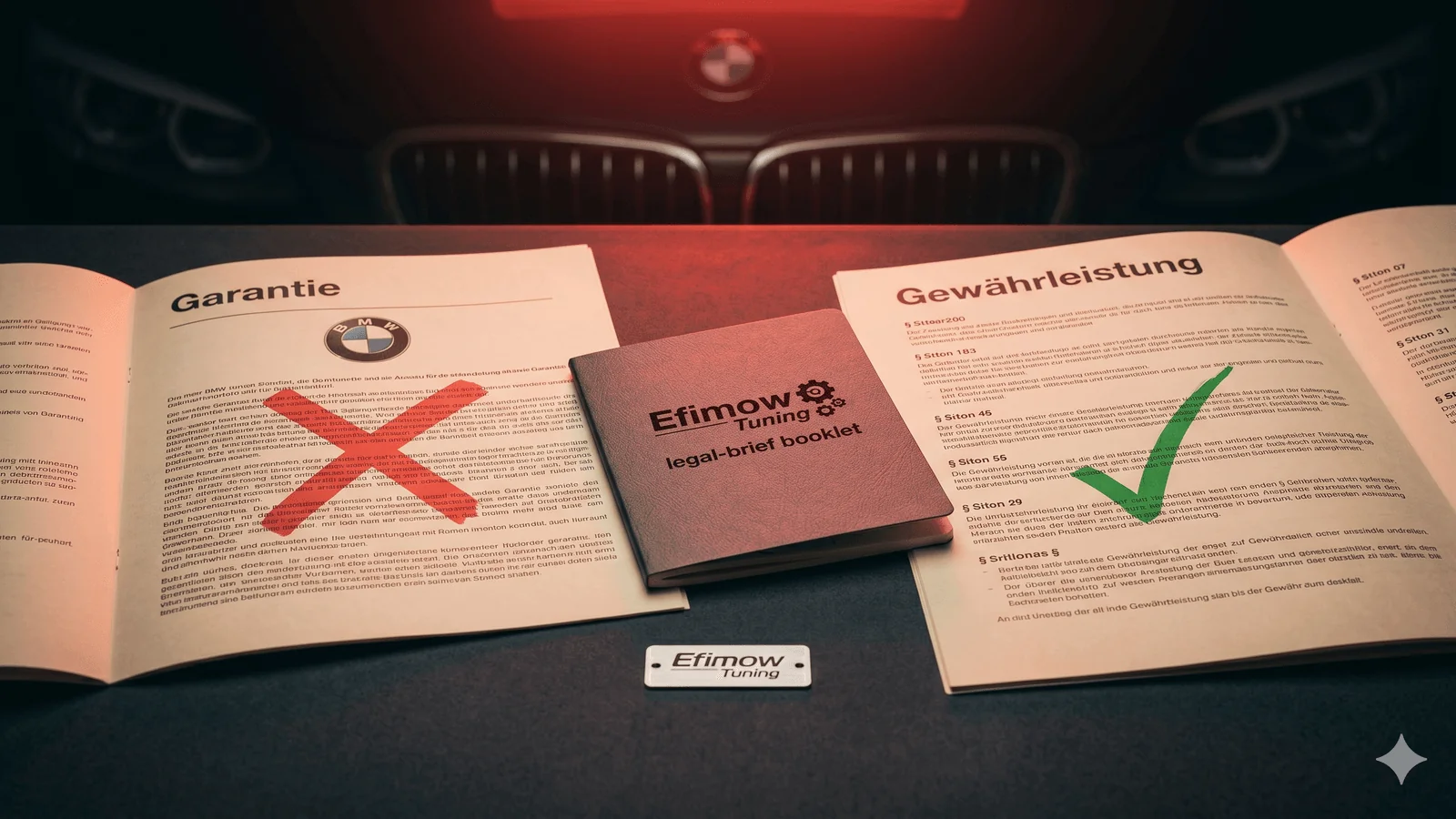
Few questions come up as reliably in a customer conversation as this one: "Will a tune void my warranty?" The honest answer is not a simple yes or no, because the question itself blends two legally very different concepts. German law splits them sharply: Gewährleistung (statutory warranty under German § 437 BGB) and Garantie (manufacturer's voluntary warranty). Once you separate them cleanly, you'll see that a professional tune carries fewer legal consequences than the bar-stool wisdom suggests, and a few more than some tuning shops like to admit.
Gewährleistung: the Seller's Statutory Duty
Gewährleistung is defined by statute, in §§ 437 ff. of the German Bürgerliches Gesetzbuch (BGB), the civil code. It is not a courtesy from the seller, it is an obligation: if a thing carries a defect at the moment of handover, the buyer can demand cure, meaning repair or replacement. On a new car the period is 24 months from delivery; on a used car the seller may shorten it to 12 months. The reference point matters: Gewährleistung covers only defects that already existed at the moment of handover, even if they show up later.
This is exactly where most customers misunderstand the legal picture. A subsequent chip tune does not automatically extinguish the Gewährleistung. The claim still exists. It refers to the condition of the thing at the time of sale, not to later modifications. A defect that was present back then (for example a known design flaw on the timing chain of a particular engine) remains a defect, even if the car was tuned in the meantime.
What does change is the burden of proof. During the first twelve months after delivery, the law presumes that any defect that surfaces was already present at handover. The seller has to prove the opposite. After twelve months that reversal of burden falls away. From then on, the buyer must actively show that the defect existed originally. On a tuned car this proof is harder to establish, because the seller can plausibly argue that the tune is the cause.
Garantie: the Manufacturer's Voluntary Promise
Garantie (manufacturer's voluntary warranty) is something fundamentally different. It is voluntary, and it is anchored in § 443 BGB only formally; the actual content is defined by the warrantor itself, typically the manufacturer. BMW, for example, gives a 24-month new-vehicle Garantie without mileage cap, plus optional extended Garantie packages a customer can purchase. The terms are written into the warranty conditions, and that is also where the conditions for forfeiture appear, typically unauthorized intervention into the powertrain.
A professional software tune falls into that category. The manufacturer is allowed to write into its terms that a modification of the engine controller voids the Garantie for the affected area. This rule is legally permitted, because Garantie is a contractual additional service whose conditions the provider designs itself.
What the Garantie Forfeiture Actually Covers
In practice, the scope of forfeiture is often misrepresented, both by dealerships and by some tuning shops. A tune does not extinguish the Garantie wholesale, it extinguishes it only for the powertrain. The components typically affected are: engine, transmission, differential, and exhaust system including the catalytic converter and particulate filter. These parts are considered technically tied to the engine controller, so a changed load profile can in principle affect their service life.
What is not affected often gets overlooked in the conversation: the infotainment system, the climate control, the window regulators, the seat heating, the driver-assistance sensors, steering components, the suspension outside of the powertrain, the body, and the cabin electrics. If a seat heater fails or a navigation display dies, the link to a software tune of the engine is so tenuous that the manufacturer cannot blanket-deny a Garantie claim on it.
Kausalzusammenhang: the Decisive Concept
The term that the discussion actually hinges on is Kausalzusammenhang (causal connection). The idea: there must be a plausible causal link between the modification and the failure that occurred. This is not a theoretical filter; it gets examined concretely in any dispute. If the turbocharger fails after a Stage 1 tune, the manufacturer will point to the causal connection, understandably, because the turbo is part of the powertrain. But if the electric mirror motor fails three weeks after the tune, such a connection is technically excluded.
In a dispute, the burden of proof for the causal connection generally lies with the manufacturer. It must show that the tune caused the damage or at least contributed to it with high probability. Blanket rejections that simply say "the car is tuned" are not legally sufficient. The logic from the German Versicherungsvertragsgesetz (VVG, the law governing insurance contracts) does not apply here directly, but the principle is related: any rejection of a benefit needs a concrete reason, not a general suspicion.
What You Should Do as a Customer
Anyone having a vehicle tuned suffers no statutory loss of Gewährleistung. On the Garantie side you should know that the powertrain may be affected, the rest typically not. It makes sense to have the tune entered into the vehicle papers via a Teilegutachten (TÜV component report) or via individual approval under § 21 StVZO. This has no effect on the Garantie itself, but it creates clarity towards the insurer and the TÜV inspector. It is equally sensible to document the prior condition: an OBD readout before the work, a written confirmation from the tuner detailing the changes performed.
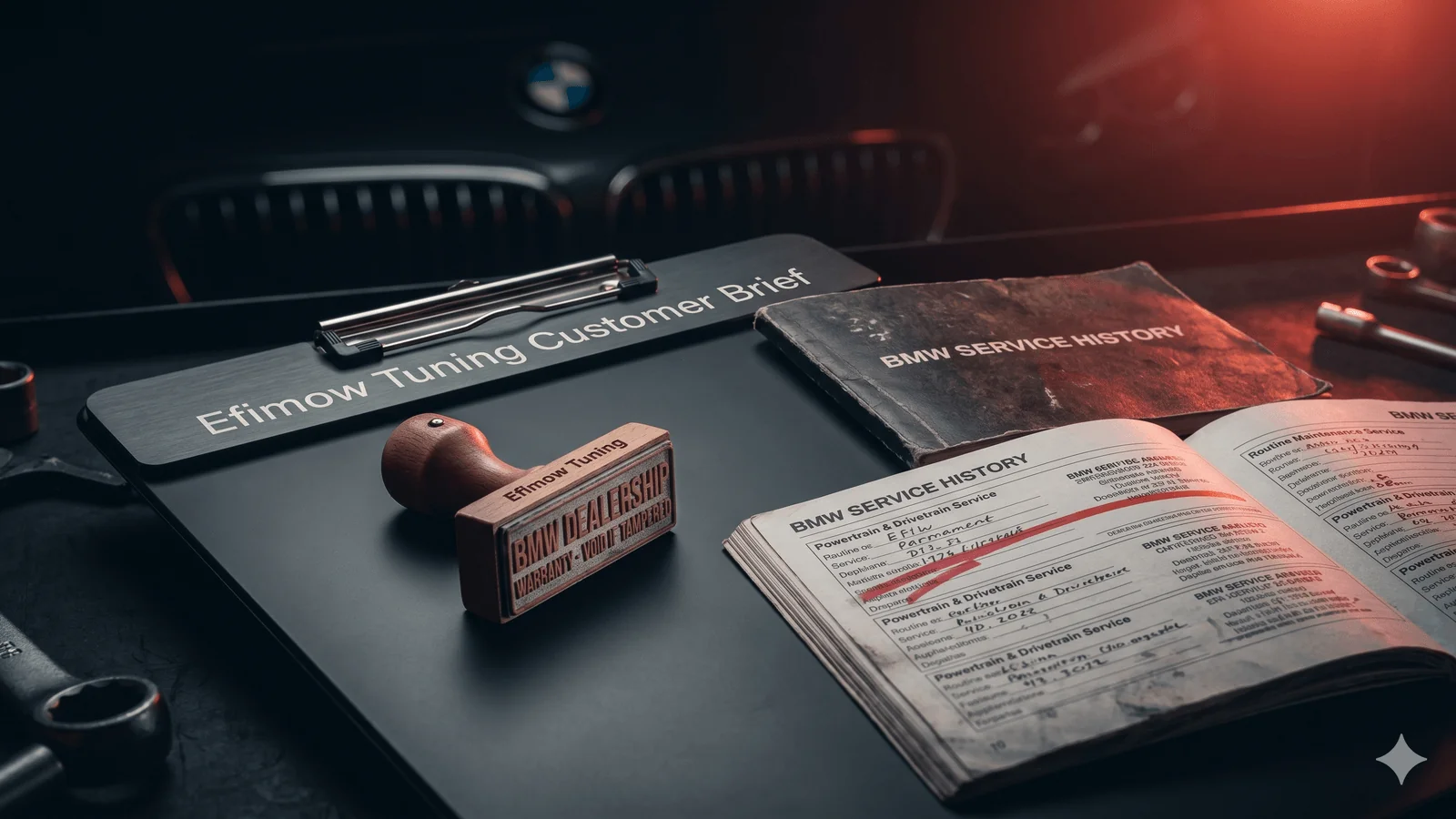
In a dispute you stand much better that way than customers who document nothing and end up in a he-said situation with the manufacturer. A clean shop stamp on the prior condition, the original software kept as a backup, and a complete service history with all scheduled inspections logged help just as much. None of this costs anything, but in a real claim it is the difference between a substantiated argument and a powerless exchange across the service desk.
Garantie and Gewährleistung are not a fog. They are two clearly separated concepts, and once you know the difference, you do not let yourself get brushed off at the dealer with a blanket "voided."