
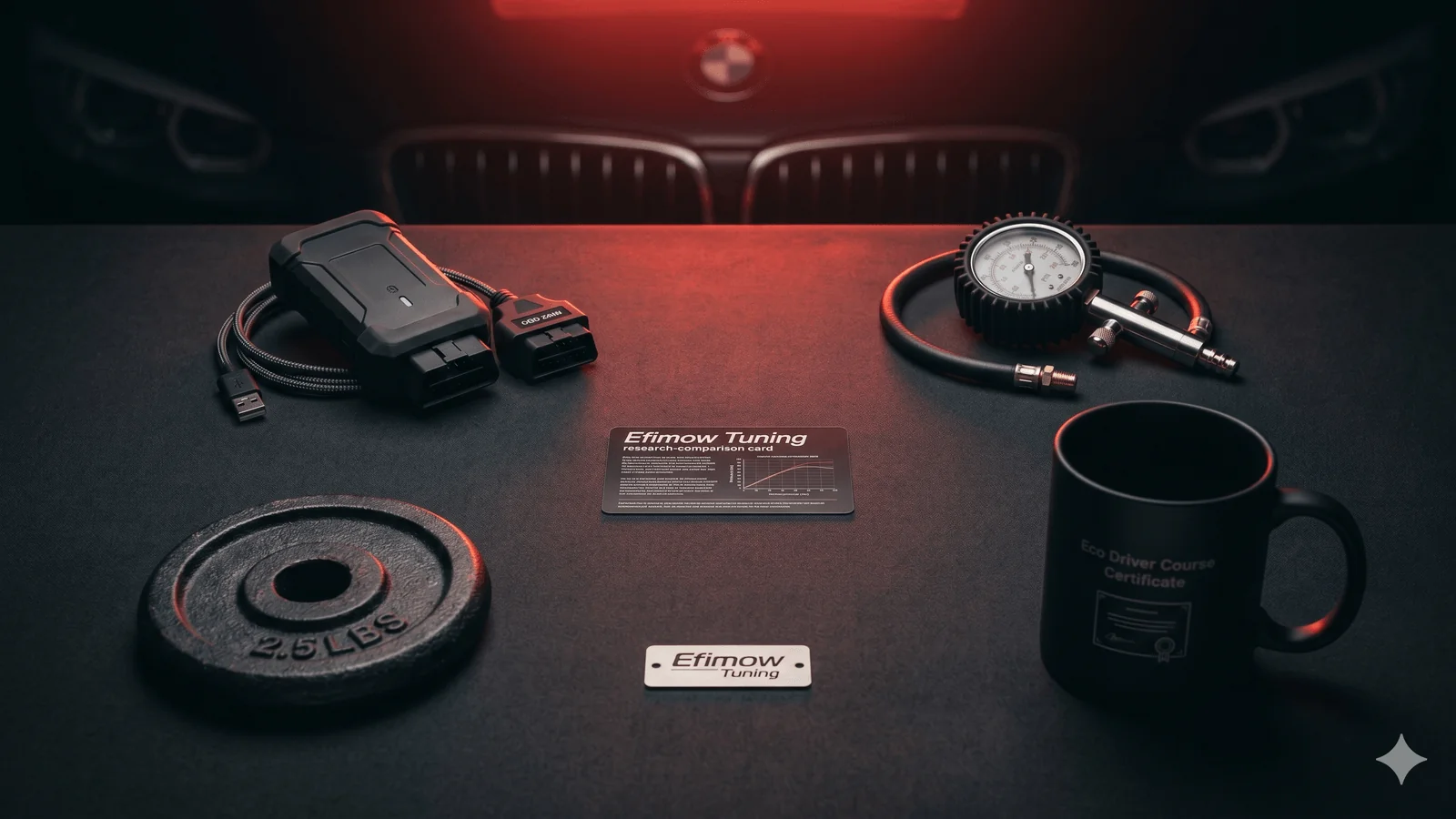
Eco-Tuning vs. Tire Pressure vs. Driver Training: Where the Real Savings Are
An honest comparison: which measure saves how much, what each costs, and which one pays for itself fastest.
May 6, 2026 by Leo Efimow
Anyone trying to noticeably cut a BMW's fuel bill has more options today than ever before. Eco-tune ads promise double-digit savings, a tire-pressure habit supposedly pays for itself in weeks, and a driver-training course is sold to fleets as the lever that beats them all. Three promises, three price tags, three very different effects. Once you compare them honestly, the picture becomes clear: the most expensive measure is not automatically the most effective, and the most effective rarely has anything to do with the car itself.
The Four Levers at a Glance
Four measures show up again and again in BMW-owner conversations. Each one acts on a different part of the fuel-consumption equation, and each has its own personality in terms of cost, effect, and effort.
Eco-tuning modifies the ECU software so the engine builds torque earlier in the part-load region, the region where the car spends most of its life. Higher efficiency at typical cruising loads, equal or slightly reduced peak figures. Realistic effect in mixed driving: 5 to 15 percent less fuel consumed.
Tire-pressure optimization simply means: correct, slightly elevated cold inflation pressure. Every bar below the target costs measurable range, because rolling resistance grows roughly with the square of the pressure shortfall. Disciplined monthly checks deliver up to 5 percent.
Removing dead weight sounds trivial but is heavily underestimated. The spare wheel, the toolbox in the trunk, last season's sports gear: 30 to 60 kilograms add up quickly, and every brake and every acceleration pays for them. Rule of thumb: 0.3 to 0.5 liters per 100 km for a permanent extra 50 kg.
Driver training (eco-driving course) does not act on the car at all. It acts on the driver. Anticipating traffic, using deceleration cutoff deliberately, choosing the correct shift point, smooth pedal inputs. Studies from Germany's ADAC and from large fleet operators show savings up to 20 percent in real-world tests, and 10 to 15 percent sustained over time.
Comparison Table
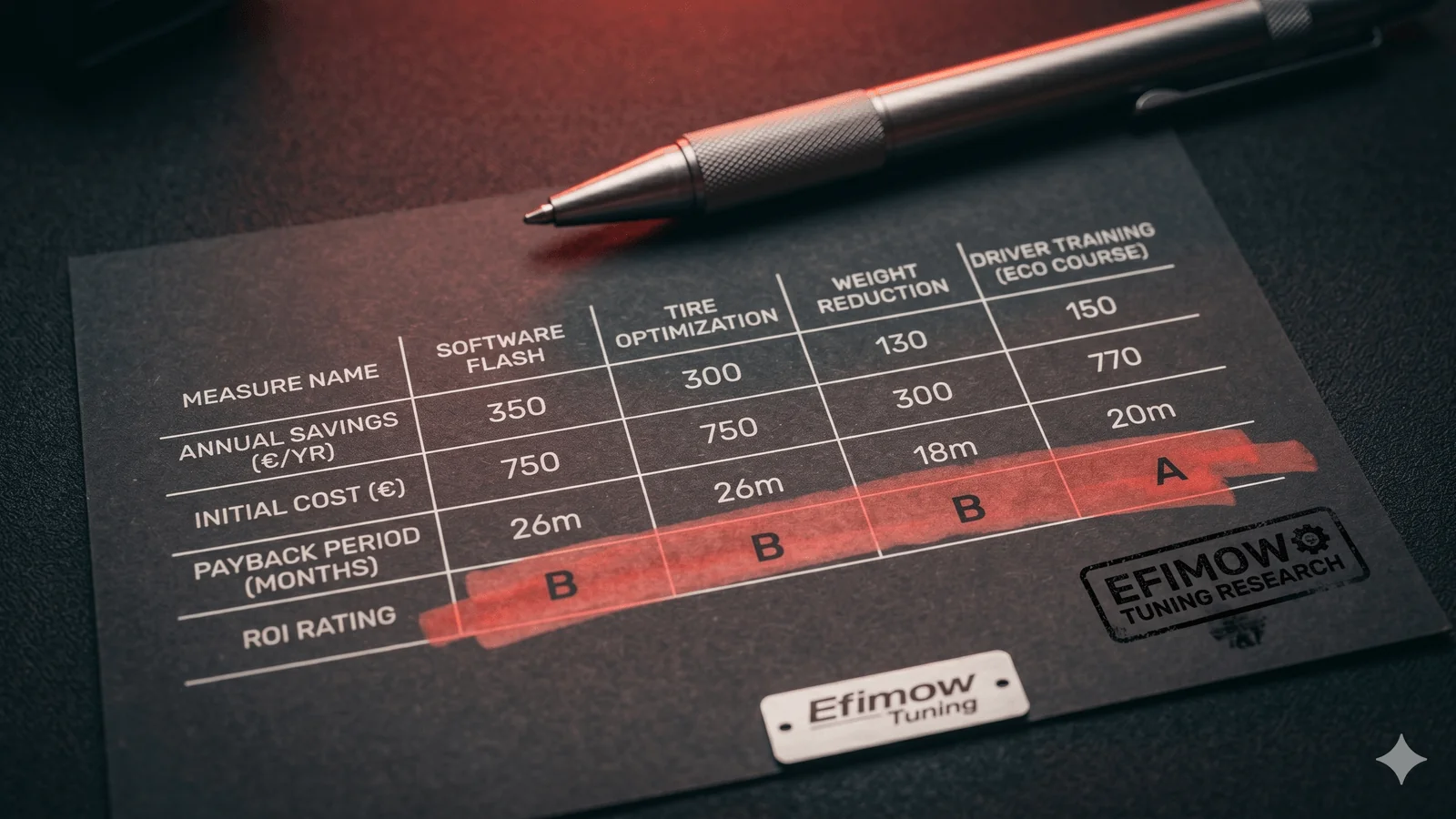
| Measure | Savings | One-time cost | Effect from | Payback* | Lasting effect? |
|---|---|---|---|---|---|
| Eco-tuning | 5–15 % | €400–€650 | after flash | 3+ years | yes, while software stays active |
| Tire pressure | up to 5 % | €0 | immediate | immediate | only with monthly habit |
| Remove ballast | 0.3–0.5 L/100 km | €0 | immediate | immediate | only with discipline |
| Eco-driving course | up to 20 % | ~€200 | after course | < 1 year | yes, with periodic refresh |
*Assumption: 15,000 km annual mileage, diesel ca. €1.80/L, baseline consumption 7.5 L/100 km.
What the Table Means in Practice
At first glance, eco-tuning and an eco-driving course look similar in scale. The decisive difference is in cost per percentage point. An eco-tune for €500 with a real 10-percent saving costs an effective €50 per percent. A driving course at €200 with 12 percent sustained savings comes in around €17 per percent. Over 50,000 km of driving, the training effect wins clearly, provided the driver actually keeps applying the technique.
That "provided" is the catch. An eco-tune still works on the day you slept poorly and your right foot is impatient. A driving course only works as long as you remember what was taught. Studies suggest that, without a refresher, roughly half of the effect is lost after six to twelve months. So the honest answer is: both have their place, but for different driver profiles.
Tire Pressure and Ballast: the Underrated Winners
Tire pressure and dead-weight removal cost nothing and work instantly. Yet many drivers underestimate both, because each individual effect looks small. Run the numbers concretely: a BMW G20 320d with correct tire pressure and without the 18-kilo spare in the trunk easily saves 80 to 130 liters of diesel over 15,000 km of annual driving. At €1.80 per liter that is €150 to €230 per year, for a habit you implement at the gas station in 90 seconds a month.
Method matters. Tire pressure is read cold, ideally in the morning before the car has been moved. The value printed in the fuel-cap chart is a lower bound; for vehicles with a full load and a fair share of motorway driving, an extra 0.2 to 0.3 bar over the comfort setting is felt both at the pump and in even tire wear at the tread center.
When it comes to ballast, it pays to clear the trunk completely once a quarter and only put back what is actually needed week to week. Roof boxes and rear carriers are a special case: a mounted roof box quickly costs an extra liter per 100 km at motorway speed because of the added aerodynamic drag. Taking it off as soon as the holiday ends is the single most effective measure on this list.
When Eco-Tuning Genuinely Makes Sense
Eco-tuning is not a bad product, it just has a narrow sweet spot. It becomes economically reasonable in three specific cases:
First, at high annual mileage above 30,000 km. There the payback shrinks to under two years, and the constant effect also helps on long highway stretches where driver-training discipline tends to slip.
Second, on fleet vehicles with rotating drivers. Here the operator cannot install good habits "into the foot" of every driver via a course. The calibration has to live in the car. This is where the higher price tag pays off most clearly.
Third, as a complement to an eco-driving course. The two combined do not produce 20 plus 12 equals 32 percent, because the effects overlap. Realistically, the combined sustained saving lands around 18 to 22 percent. Anyone chasing the maximum combines both training and software.
Bottom Line
When you compare the four measures soberly, driver training wins on cost-versus-effect. Tire pressure and ballast removal are the fastest and cheapest immediate measures, and the ones most often forgotten. Eco-tuning earns its keep mainly with high-mileage drivers and fleets, much less with the 8,000-km-a-year commuter. Before any spend, an honest look at your real annual mileage and your real driving style is worth more than any product comparison. In nine cases out of ten, the biggest savings sit not in the ECU but in the right shoe and in the tire-pressure gauge.